Thu, 9 Dec 2004, 10:59 AM Warren Johnson Looks Toward 2005 |
Courtesy of Jeff Romack, GM Racing Photo copyright 2004 Auto Imagery, Inc. |
SUGAR HILL, Ga. --
 Warren Johnson
|
Like all great competitors who make the difficult decision to remove themselves from the field of play, whether it's Joe Montana, Cal Ripken, or Michael Jordan, Warren Johnson has been a trailblazer in regards to his influence on his respective profession. It is difficult to imagine a national event where "The Professor" won't be applying his engineering expertise, but over the course of four decades as an accomplished racer, engine builder, chassis designer and safety equipment proponent, Johnson's impact has been felt in all corners of the sport of drag racing. His inventive work with General Motors in the early '80s toward the development of the DRCE (Drag Racing Competition Engine) is still the benchmark in Pro Stock, and subsequent versions of the DRCEII and DRCE III promise to benefit racers in the category for years to come.
"When you think about General Motors and drag racing, one name comes to mind, and obviously that's the 'The Professor,' Warren Johnson," said Fred Simmonds, GM Racing Group Manager Drag Racing. "I can't think of any driver who's had a more important impact on his class than Warren Johnson, from a performance standpoint and even from a safety standpoint. Take a look at the roll cages in a Pro Stock car; that's Warren Johnson. The beadlock tires? Warren was on the leading edge of that technology. Everyone knows the stats - he is Mr. General Motors Drag Racing."
 Johnson at the WinterNationals.
|
In 2004, an incredible trifecta of performance streaks for Warren Johnson came to end including 22 straight seasons with at least one national-event victory, 22 consecutive top-five points finishes (both dating back to 1982) and 16 consecutive years with at least one raceday pole award. With last year's runner-up finish at the NHRA Winternationals, Johnson continued a streak of 23 race seasons in which he's competed in at least one final round.
Original development of GM DRCE - "The DRCE came into being when Hurst wanted to commemorate the 15th anniversary of the Hurst Olds in 1983. It was supposed to have been finished by the middle of 1982, but by November nothing had been accomplished on it so I took over the project myself. The cylinder head and block, I believe it was a 10-day mad thrash to get the pattern work, or prototype, made so we could cast some cylinder heads. Actually, the original prototype was first done in wood. That's what started the development of the DRCE. Oldsmobile didn't want to use a Chevrolet engine, which was the base engine for GM in Pro Stock at that time. Olds wanted something they could call their own and that's the genesis of the DRCE series of racing engines. Over the past 20 years it's been, shall we say, a work in progress. The first major redesign of the DRCE was in 1991 and '92. The block was revised and a better casting was made for the cylinder head because the original pattern work was done in such haste that we really didn't have time to finesse it. In the early '90s, the cylinder head was redone and completely retooled. Basically it was the same cylinder, it just had new tooling. That same basic cylinder head is still being used today."
That design, barring any unforeseen changes in Pro Stock, promises to be around for a long time. "It's really been the mainstay of GM's Pro Stock effort for the last 23 years now. Right now the DRCEII is the best performing engine out there, but the DRCEIII we're working on currently shows some promise as well. The potential of the DRCEIII is in the block because that lends itself to a higher rpm with the way it stabilizes the valvetrain and ultimately it will be the way to go. The block on the DRCEIII is still about 48 pounds heavier than the previous block so there's a lightening operation that you have to be involved with."
Innovations you've made in safety and the pride you take improving the sport in that area. "I'm the last guy who wants to see anybody get hurt doing what they enjoy, and that's racing. Safety to me has always been a primary concern. You need performance, but at the same time you need an equal helping of safety. These cars are going quick enough, and fast enough, that certainly, people have been hurt in the past - I remember a number of incidents where people have lost their lives. I've looked at what was left of cars, surmised what happened and that's where the roll cage design that we have today came in. We did that back in 1984 or '85. The dual parachutes was another area that we worked on with Stroud Safety because I saw so many failed deployments of parachutes that by adding a second parachute you double your chances of at least one chute opening. We're currently revising our seat design because I looked at Brandon Bernstein's accident at Englishtown and that prompted us to make some changes."
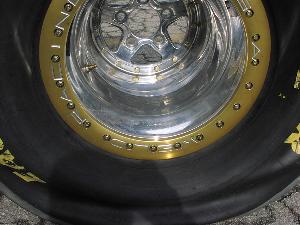 The new beadlock.
|
How did you reach your decision to get out of the racecar? "Nothing is forever and I've looked at it that I need more time in the shop to get the development work done to increase the performance of these cars. It's something that I had to do. I'll certainly test drive, and I may sporadically run an event or two, but as far as a full-time position, I think it's something I need to do for Warren Johnson Enterprises, for Kurt's car, my car and whoever we put in my car in the future. We need to increase the performance of these vehicles and that's going to take more of my time. We're on a limited budget and we have to make every nickel count. I was born handicapped, with only two hands, so I need more hours."
Is driving a racecar something you'll miss? "No, I never have missed it. Driving the car has never been my bailiwick. I enjoy it if I have an ill-handling car, then I have something to do and it makes it more interesting. But for the most part it's something that just came with the territory. Like I said before, when I first started Arlene wouldn't drive, Kurt was too young and the dog couldn't get a license so I was basically stuck with it. The car to me is a place to test everything we've been working on."
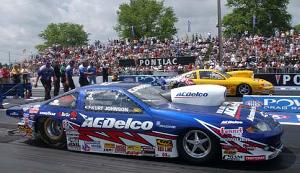 Kurt vs Warren
|
What will you do between now and next February that will put you back in the hunt for the championship? "We have a new car and that will be part of the equation. The car will be done in about three weeks and that will help. We have complete new engine assemblies that we've been working on, and now that we won't be attending any races for the next two and half months, that will bring us back to where we need to be. I just need more shop time so the offseason will benefit our program multifold."
What plans are in place for the transition of putting a new driver in the car? "We'll go full bore in 2005 and if we see eligible candidates as far as drivers are concerned, I've got spare cars. We'll put them in a car at a few national events just to get them used to running the way we run our program. That way they'll be up to speed in 2006."
Ready to take your order at 1-800-230-3030 | Customer Service 1-800-517-1035