Sun, 07 Jan 2018, 19:02 PM Creatures of the Night Part IV |
By Steve Reyes Photo copyright 2018 Steve Reyes |
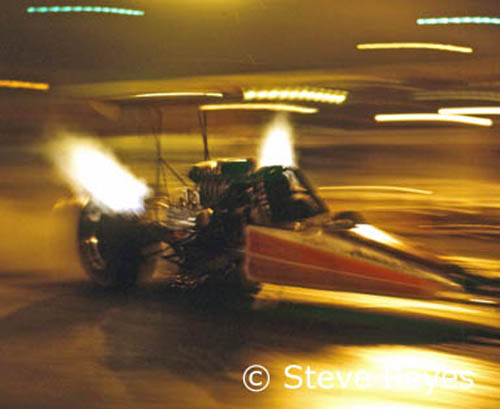
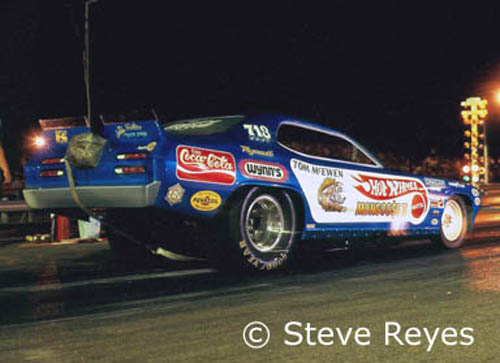
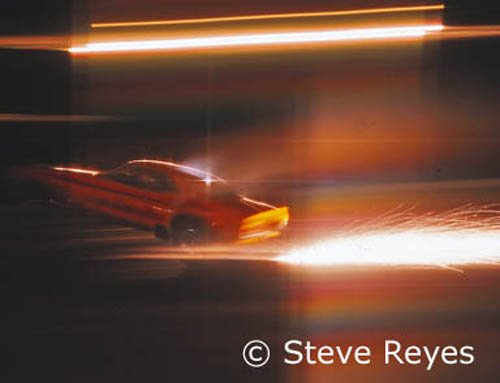
Here is the final segment of "Creatures of the Night". This part features a different array of drag racer's doin' it after dark. Quite a few of the photos featured are "flame shots" taken with the camera mounted on a tri-pod. To get the best "flame shots" took skill and a lot of luck. The skill would be figuring out the starting line light sources and how they light up your subject. The luck portion was hoping that the car you're shooting stages first, taking a deep breath, shutting out the roar of the engines and pushing the shutter all at the right time.
If I was shooting color slide film there was no room for error, the exposure had to be right on. There were no do-overs or fixing an under-exposed or over-exposed slide, it was just junk. It was not like today's hand-held computers (a.k.a. digital cameras). Those things do everything but wipe your nose. Also, these time exposure photographs pleased many a promoter by showing the size of the crowd and all those signs that featured sponsors of the race track.
The flame shot time exposure is a lost art. With the different way that nitro burning engines are set up in this modern era there are no real flames present when the cars stage, so no cool flames to shoot. Like many other things in drag racing, it's just another lost part of drag racing that is gone forever.
If you wish to purchase prints of the photos below or any others, they may be obtained by contacting us at breyes@reyesontour.com. Other photos for purchase may be viewed by following the links at www.reyesontour.com.
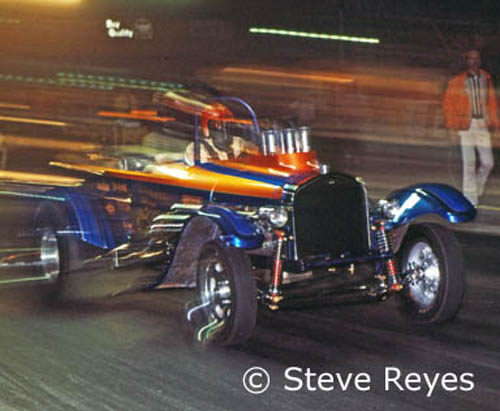 |
f-stop, shutter speed and length of lens. Fred Badburg's A/SR was caught
charging off the Lions drag strip starting line in 1972.
 |
 |
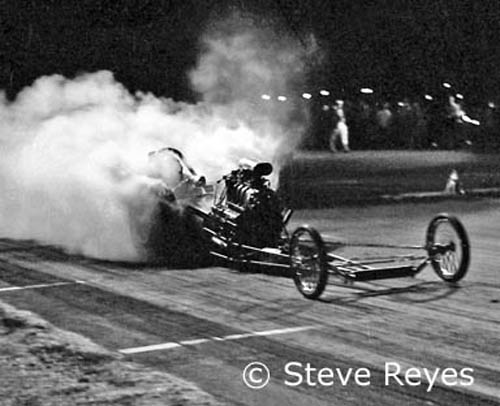
This was black and white film shot at 1600 a.s.a. with just the starting line lights.
In 1972, it was controlled chaos on film at Lions Drag strip. Bob Noice exploded
from the starting line with the Brissette and Noice Avengers top fuel dragster.
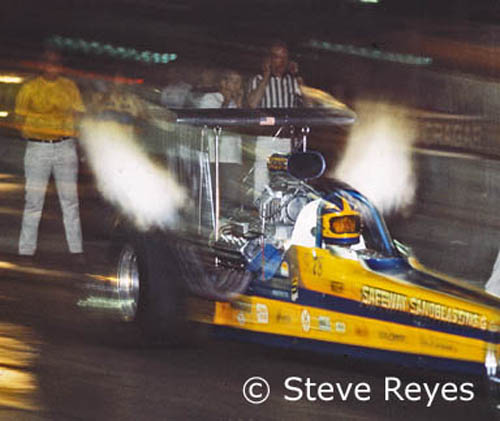
The shot was taken with color slide film rated at 640 a.s.a., with a long lens,
slow shutter speed and one-third power on the strobe.
 |
winner Carl Olson took his turn down the quarter-mile. Carl was piloting Jack Ewell's
AA/FD with huge flames belching from the Ewell 426 Hemi. Nothing like a top fuel
flame shot Irwindale.
 |
 |
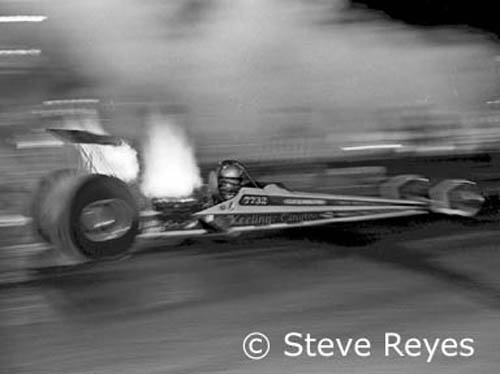
driving at OCIR; then at Englishtown, New Jersey, we found Vic Brown in the Creitz and Dill
top fuel dragster. Jake's photo was a simple pan shot with available light, of course.
The Creitz and Dill flame shot was planned to show the crowd at the Summernationals.
It was a tough exposure but it came out okay.
 |
 |
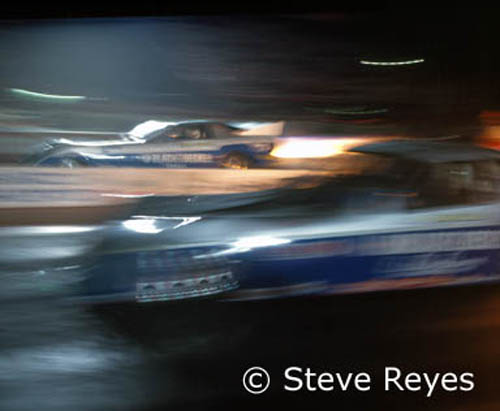
John Wiebe vs. James Warren at Lions Last Drag race in 1972 and Don Prudhomme with
his Feather top fuel dragster at the 1973 PDA race. Different light sources produced
great affects and brought out the crowd and feel of the race.
 |
at Lions in 1972 is illustrated in this artsy photo. Back engine fuel cars gave me a different
type of action shot to capture on film at night.
 |
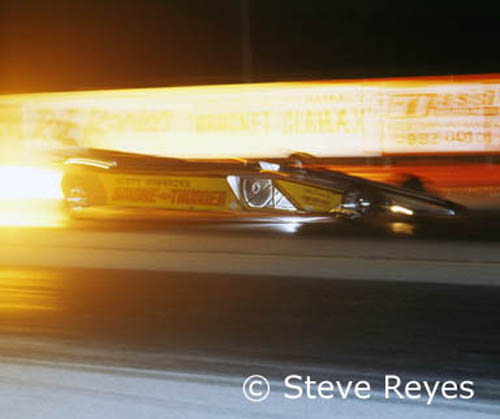 |
are cars that have their very own bright light source coming out of their tail pipe.
Both of these photos were just playing around with film and the light from the
engine tail pipe. The jet funny cars of Roger Gustin came out okay but I really like
the whole effect of Scott Hammack's Smoke and Thunder jet dragster at night.
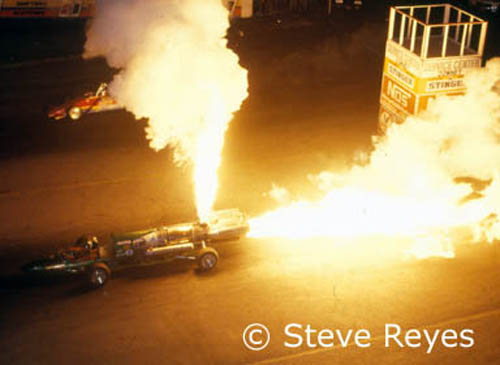 |
form the OCIR tower roof; no flash, just the light from the engine.
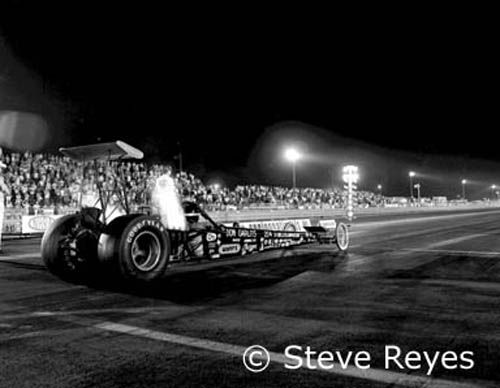 |
engine dragster. Garlits was going for low ET and wanted to upstage Kansas John Wiebe
who just set low ET for the meet. With the crowd on its feet, Garlits blasted down the
Dallas quarter-mile for low ET honors. This photo just has a great feel to it.
 |
dragster at Irwindale, California, in 1973. This photo was shot with available light.
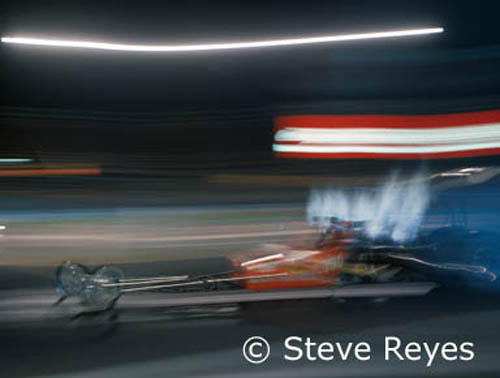 |
Why this style of photo? Because a lot of times, magazine art directors liked an
"artsy" two-page spread to drop other photos into for wild coverage of a certain event.
When shooting at the races, I had to always keep in mind what an art director may
like or want. You could have taken the coolest photo ever but if it doesn't fit the
format of the magazine, the art director would reject it. I learned this very early in my career.
 |
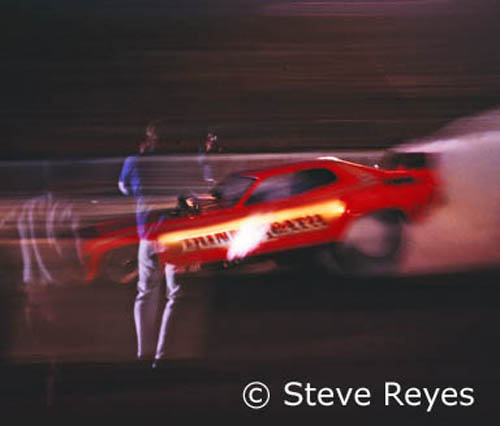 |
Oklahoma, in 1972. It was a nice available light exposure from a tri-pod. The Dunn and Reath
Satellite pan shot at OCIR turned the starting line crew into "ghosts".
 |
his Hemi-Under-Glass through its paces down the 1320.
Ready to take your order at 1-800-230-3030 | Customer Service 1-800-517-1035