Tue, 31 May 2016, 11:18 AM Happy 50th Birthday to the Funny Car Part 3 |
By Steve Reyes Photo copyright 2016 Steve Reyes |
Just as Disney celebrated their 50th birthday all year long, so we will spend some time celebrating the fifty years of funny cars. In this segment we will cover the Blue Max, Dunn & Reath, Della Woods, Shirley Muldowney, Paula Murphy, Billy Myers, Melrose Missile, Don Prudhomme, Joe Winter, Barry Setzer, The Snowman, and Flash Gordon himself, Gordon Mineo.
While this was mostly a male dominated sport in the 1970s, three women stand out as giving the men a run for their money. Early on, Shirley Muldowney received her NHRA license in 1965, Paula Murphy received her NHRA license in 1966 (the first woman to receive a nitro competition license), and Della Woods received her NHRA license in 1968. While they all raced in multiple classes, they each at one point drove funny cars much to the chagrin of many a male driver. NHRA tried to revoke the licenses on Paula in 1967 and Della Woods shortly after she got it. This resulted in both women losing bookings until they were reinstated. These women broke the gender barrier and opened up the world of drag racing for other women to follow.
Please enjoy this segment of our trip down memory lane. If you wish to purchase prints of the photos below or any others, they may be obtained by contacting us at breyes@reyesontour.com. Other photos for purchase may be viewed by following the links at www.reyesontour.com.
 |
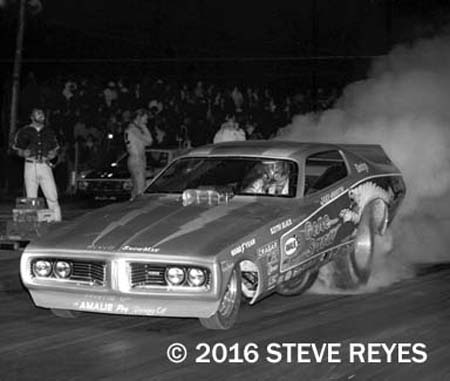 |
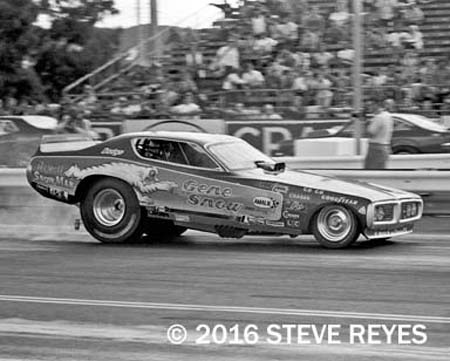
Team Revell consisted of Snowman, Gene Snow (red care) and
Jake Johnston (blue car) battling it out in the funny car class.
Based in Fort Worth, Texas, Snow and Johnston racked up
national event and match race victories all over the USA and England.
 |
Harry Schmidt's Blue Max. After leaving partner Mike Burkhart
in the late 1960s, Schmidt ventured out in the funny car world
with his Blue Max AA/FC. Paul Gordon, Jake Johnston and
Richard Tharp all had seat time in the Mustang. It was in 1974
that Raymond Beadle started to drive the 'Max. Schmidt had
tired of touring and sold the complete operation to Beadle, a former
top fuel guy, and Mike Burkhart, a funny car pilot. You may say the
rest is funny car history.
 |
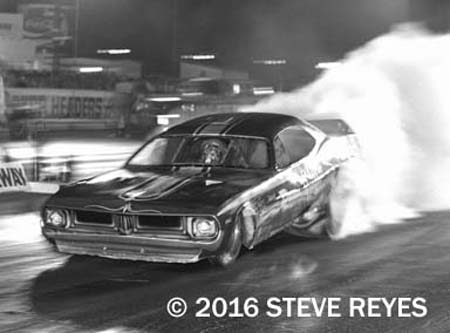 |
funny car class, a rear engine 'Cuda AA/FC. If anyone could get a
rear engine funny car to work it would be Jim Dunn. Dunn had gobs
of driving experience in the fuel altered ranks, top fuel, and conventional
funny car classes. For two years Dunn & Reath raced two different back
motor funny cars. The team starred in the movie Funny Car Summer in 1972.
The biggest highlight came at the NHRA Supernationals at Ontario, California,
in 1972 when Dunn & Reath Vega AA/FC won funny car eliminator making
them the only rear engine funny car to win a national event. After the 1973 season,
the team decided to return to a conventional funny car. Jim Dunn's reasoning,
"The car would go straight for four runs and then make a hard left." Ill-handling cars
had no future in funny car racing and Dunn & Reath knew this and fixed the problem.
 |
 |
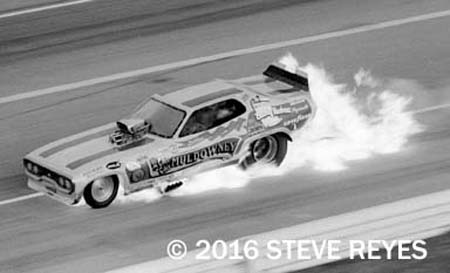 |
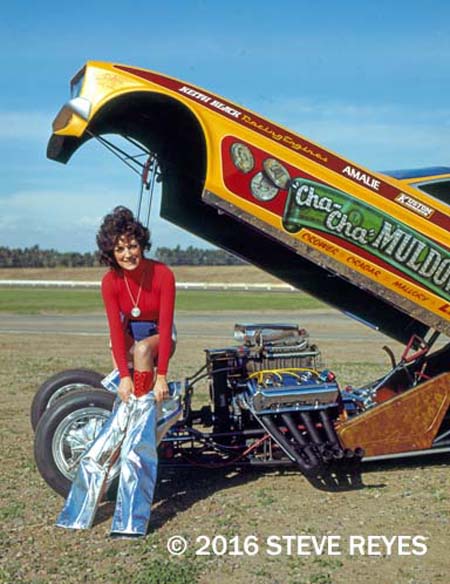
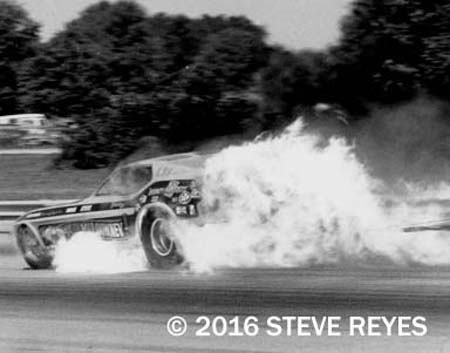
her Mustangs and Satelite funny cars. On July 31, 1971, she became
the first woman to win funny car eliminator at a national event.
The race was at Rockingham, North Carolina, at the IHRA Funny Car Nationals.
She defeated Della Woods, Casey Powell, Tom Hoover and then Connie Kalitta
in the final. After seeing her drive a funny car, Jungle Jim remarked,
"She drives like a man." Muldowney's funny car career lasted about three years
until two horrendous fires caused her to regroup in late 1973.
She returned to top fuel and of course, every drag fan knows the saga
of Shirley Muldowney and her pink top fuel dragster. She definitely has
left her mark on the sport of drag racing.
 |
The kid from Waco, Texas came to OCIR in 1972 and won the biggest
funny car event in the country, the Manufacturer's Championships.
Meyer was eighteen at the time and had just ventured out on his own
with a funny car. Before Billy hung up the fire suit and helmet in 1987,
he had collected twelve national event wins.
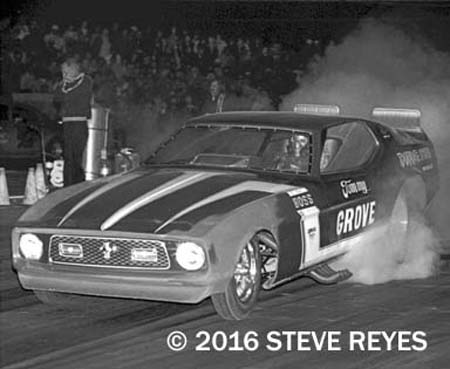 |
funny car pro was Tommy Grove. Grove made a name for himself while
driving the Melrose Missile super stock during the 1964 season.
A falling out with Mopar executives saw Grove land a ride in a
Ford Mustang A/FX in 1965. Tommy stayed with Ford during his
career as a touring funny car racer. His all-Ford Mustang funny car
was a fan favorite on the AHRA and match race circuit. Business ventures
curtailed his funny car career but in the mid and later 1970s. he could be
found behind the wheel of Barry Setzer's blue Vega.
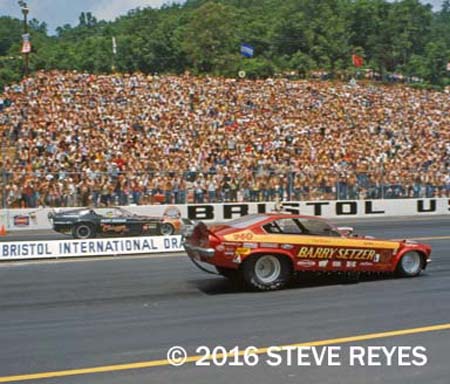 |
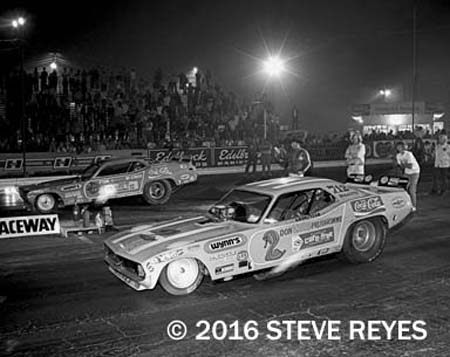
and Cliff Brown. Setzer's Vega was piloted by Pat Foster and Brown
wheeled his Chicago Kid Mustang. Both cars could be found touring
the nation's many drag ways match racing. Setzer and Foster ran NHRA
and AHRA national events besides match racing. Cliff Brown mainly
match raced his Chicago Kid with a few AHRA national event appearances.
In fact, out of all touring funny cars in the US, Brown and his Mustang
had the best winning percentage at 94%. Here the two square off in front
of a SRO crowd at Bristol, Tennessee, in 1972.
 |
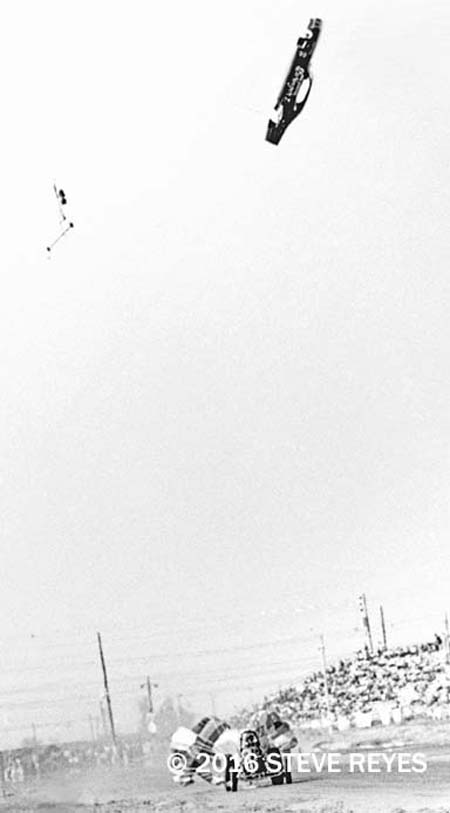
and Tom McEwen. This duo created the Snake vs. Mongoose rivalry that
put people into the grand stands wherever they raced. From their early
top fuel rivalry to their Hot Wheels funny car duels, they set the bar at a
high level for the funny car class throughout the 1970s and early 1980s.
 |
 |
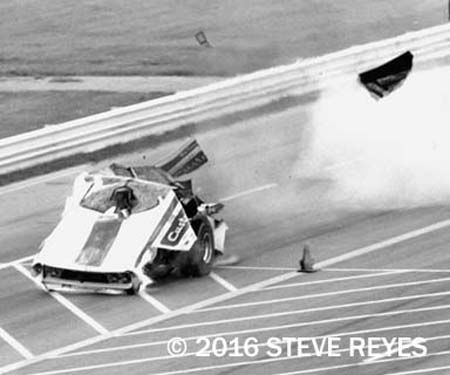 |
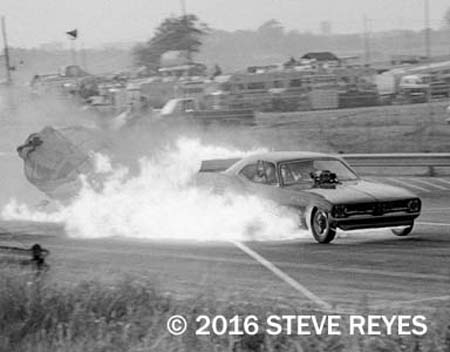
show that 1970s funny cars were fun to watch but could be very
dangerous for the driver.
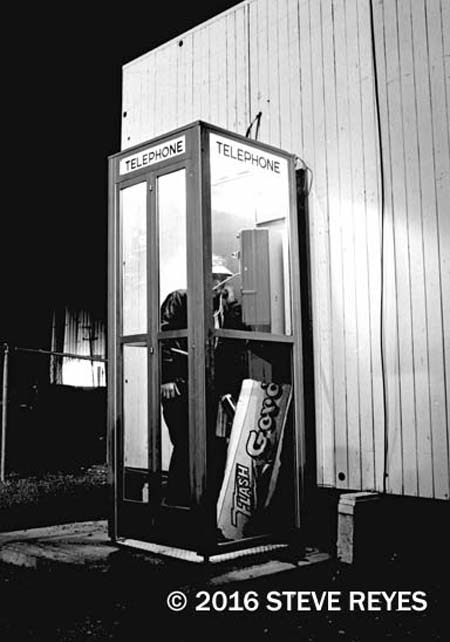 |
with a memento of his day at the drag races in Fremont, California
in 1970. Mineo provided a lot of body pieces to spectators that year.
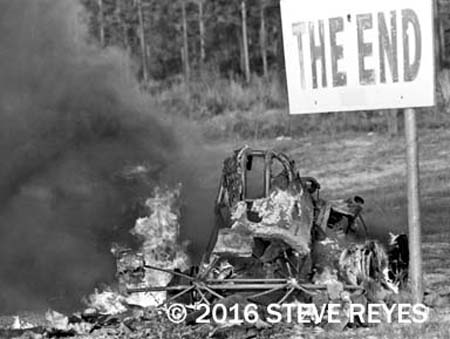 |
or burned to the ground. They included: Al Bergler's Vega, MT Grand AM (pictured),
the Frantic Ford, Eastern Raider Pinto, Trojan Horse, Brutus Mustang,
Fred Goeske's Duster, Sam Miller's Mustang, The King Camaro,
Custom Body Arrow, Bruce Larson's Camaro, The Bad Habit Pinto, etc.
Funny Cars could be very expensive.....
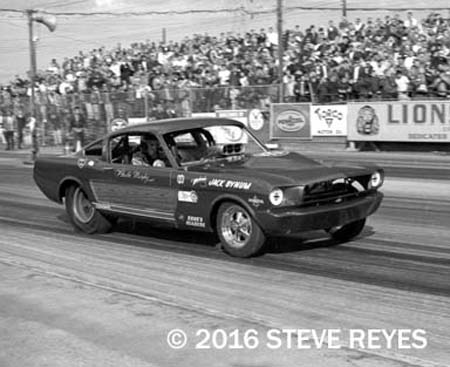 |
crazy early days of the class was Paula Murphy. Ms. Murphy was
the first woman to be granted a NHRA license to drive a nitro burning car
of any kind and of course, she chose her STP funny car. Late in 1966 and
1967 she raced her Mustang funny car with her mechanic Fat Jack Bynum.
In 1971, she drove an all new Miss STP Duster bodied AA/FC until 1973
when she took it to England and sold it.
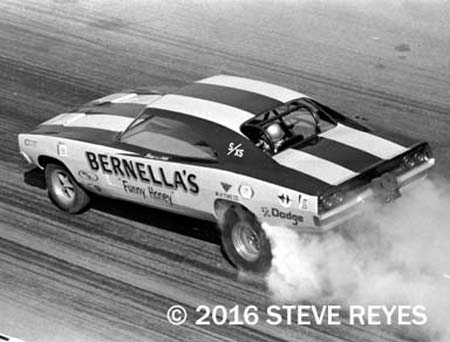 |
will mention Shirley Muldowney but the first and longest running was
Michigan's Della Wood. Heck, Della raced in funny cars before they
were funny cars but the S/XS class. She and her brother Bernie raced
their Funny Honey out of their Michigan based Speed Shop for two decades.
Ready to take your order at 1-800-230-3030 | Customer Service 1-800-517-1035