Darrell Russell
|
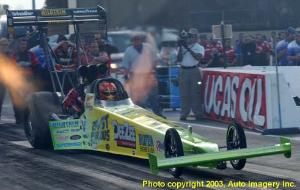
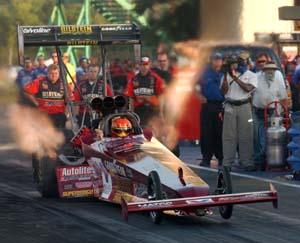
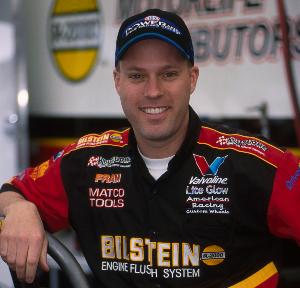
Darrell Russell, driver of the Bilstein Engine Flush dragster owned by NHRA Top Fuel
legend Joe Amato, has quite a resume. He's had some pretty interesting jobs, from raising
mini-donkeys on his Hockley, Texas, farm, to working for some of the biggest Fortune 500
companies as an computer information technology specialist. He even spent some time
running the show as tour manager for country music superstar Clay Walker. But three years
ago Russell gave all that up to chase his dream. A lifelong high-performance enthusiast,
Russell became a hot commodity among high-profile Top Fuel and Funny Car team owners late
in 2000. A standout in the NHRA Lucas Oil Drag Racing Series, first in Super Comp and
later in Top Alcohol Dragster, Russell was tabbed a rising star and lauded by such drivers
as three-time Top Fuel champion Gary Scelzi. Amato won the lottery and signed Russell to
drive his Top Fuel dragster in 2001. After an impressive rookie campaign which included a
victory in his very first event behind the wheel and seven final-round appearances, Amato
signed the talented 34-year-old driver to an extended contract during the 2002 season.
This season Russell has emerged as a contender for the NHRA POWERade Drag Racing Series
championship, as he, crew chief Wayne Dupuy and the team have moved into third place in
the top 10 standings. In this Q&A, Russell talks about the adjustments he has made in his
transition from sportsman competitor to a top professional contender, working for a legend
in the sport like Amato, and the commitment it takes to drive a Top Fuel dragster.
Q: What has been the biggest change for you in your transition from the sportsman
to professional ranks?
RUSSELL: When I was hired by Joe I felt pretty confident I could handle the
racecar, just because of all the years of experience I had in the sportsman classes. I
started in a Super Comp dragster, then drove an Alcohol Dragster, and then moved to Top
Fuel, so it was a natural progression of increased speed. When I was hired and then again
after I won my first race in Joe's car, I realized very quickly that the media demands
were going to be unlike anything I'd experienced before. I'm not a real outspoken type and
I thought it was going to take a lot of getting used to, having cameras around all the
time and having to be on TV. Fortunately it came a lot easier than I thought it would. I
learned that you just have to be yourself and talk to reporters like you are talking with
your friends.
Q: Now you have fans who want autographs and you have to be conscious of the image
you are projecting at all times. How have you dealt with being in the spotlight?
RUSSELL: I love interacting with the fans. I was on the other side of the ropes for
many years so I know how the feel. I really try and take a moment with each person to make
sure they're having a good time at the races, because that's what it's all about. As far
as image, I've gotten in the habit of taking a moment and collecting my thoughts when I'm
getting interviewed on TV. It can be a little difficult sometimes. You get caught up in
the heat of the moment and you are getting out of the car and you really haven't had time
to think and all of a sudden you have a microphone in your face and they're asking you
questions. To try and make sense of something your brain is still processing and make
sense, plus plug all the wonderful sponsors we have and need to make this car run without
sounding like a commercial can be tricky.
Q: What do you think is the biggest pressure these days on a Top Fuel driver?
RUSSELL: For me it's living up to the legend of Joe Amato. He's the best there ever
was and he has an incredible winning percentage, yet he hired a guy like me with no
experience. A recommendation from my buddy Gary Scelzi is the main reason I am here. I put
a lot of pressure on myself to try and continue the winning traditions Joe had for all
those years. As a driver I put added pressure on myself to go out there and perform day in
and day out and try and be as consistent as possible to eliminate that variable all
together.
Q: You won the first national event you entered in Top Fuel and only three other
drivers had done that before you in the history of the sport. Did that race give you a
misconception about how tough the category really is?
RUSSELL: No. I think I had a real good idea of how tough it is because of my
friendship with guys like Gary Scelzi. I knew that everything just happened to fall into
place for us that day. It was a cool start. It's great when the car is running good and
there's no problems. But it's rarely like that and I think the challenges of putting a
good racecar and team out there are what bringing us back race after race. A true driver
is made when the car has problems, like losing traction and smoking the tires on Sunday,
then you're trying to do whatever you can to get to the finish line. That's when you are
truly tested as a driver. For me, that took some time to learn. Even today if the car is
smoking the tires, sometimes you can get it corrected and sometimes you can't. It's really
incredible how difficult it is.
Q: It seems like you and Joe have a good relationship. How has it been for you to
work for him?
RUSSELL: First and foremost the knowledge base that he has is incredible. He has
been racing for so many years. If it has happened in drag racing, most likely it has
happened to Joe. It is such a tremendous asset for me to have that bank of knowledge to
draw from. If I have any kind of question on driving he can answer it. That's a huge
advantage for me.
Q: This year Joe hasn't been as visible around the track as he was during your
first couple of years. Does he now trust that you and Wayne Dupuy (crew chief) will make
the right calls and he doesn't need to be on-site as much?
RUSSELL: He's feeling comfortable in my driving ability and how Wayne and I work
together. I really wish he was around more often because it means a lot to me when he's
there. At the same time it does feel good that he trusts us and basically throws us the
keys to the company car. I know he is very busy with a lot of other business interests.
Q: You talked about Amato's incredible winning percentage over his career, but you
are building quite a winning record of your own at 83-56 in elimination rounds. Are you
proud of that accomplishment, considering some top drivers are still trying to get back to
.500?
RUSSELL: I think that has a lot to do with the way Joe put this team together and
with the chemistry of the team. This is no different than a baseball team, basketball
team, or any other kind of team. If you don't have that chemistry, it is not going to
work. Wayne and I work very well together. His tune-ups work really well with my driving
style and I think that has a lot to do with why we have been good at going rounds. Joe is
always telling us how to race smart and that plays a big role in it. A lot of other teams
don't race very smart because they try to really step on it when they race certain teams.
With Joe it's not like that because he wants us to get the car from point A to point B
every time. Our odds are better of winning rounds if we do that. I guess my winning
percentage shows there's something to that strategy.
Q: How is the one-piece body design coming along? Do you think it will be as
revolutionary as the rear wing, another Amato original design?
RUSSELL: The project is going well. The concept was created last year by Wayne and
car builder Brad Hadman. We designed the body after watching the conventional bodied
dragsters on slow motion video. You could really see the panels waving and flapping a lot.
Now we basically have a Funny Car body on a dragster, so we don't get all that distortion.
It took about six to eight months to get this plan from the drawing board to reality. Now
that we have it, it has opened up a whole new situation because we don't have any history
with this body on the car. Every track we go to it reacts a little differently. We have to
make the adjustments to make the car work the way we want it to. We noticed right away
that the tire temperatures were going way up, which meant the body was giving us a lot
more downforce than the conventional body. We had to make adjustments to eliminate some of
that. I think it is going to work but we definitely need more research and development.
It's too early to say whether it is ever going to be an advantage that all teams will want
to utilize. It's like anything else when you try new technology you are not just going to
flip a switch and make it happen. It's something you have to continue to work with. We
have to keep our head down and keep pushing forward with the project. Joe wants to keep
this body on for the rest of the year and see if it is going to help us in the long run.
Q: You have quietly moved into third position in the POWERade point standings this
season, but really you have been very consistent with a couple of final round appearances
and several semifinal finishes. What is your strategy for the rest of the season to chase
points leader Larry Dixon?
RUSSELL: You have to be realistic about things and set attainable goals. I feel our
position right now is pretty solid. We still have to worry about the guys that are behind
us because it's not like we have a lot of distance between us. We need to concentrate on
being consistent and going rounds. First-round losses are killer. We haven't lost in the
first round since Bristol, so that's a lot of races where we've been gaining ground.
That's our strategy. Dixon and Kalitta are pretty much in a race of their own right now.
If we can maintain third and try and get a couple of wins this year, that's what we want.
We are a win waiting to happen and it's there for the taking and we know that. Probably
our best shot so far was St. Louis but I red-lighted in the semis against Kalitta. We had
a great car there.
Q: You must be proud of the fact that you have qualified for every race during your
career. You had a scare last weekend at Seattle, but now your streak is up to 61 and
counting. How much pressure are you feeling these days to keep it going?
RUSSELL: If you look at what we went through in Seattle, that brings on a
tremendous amount of pressure. I was very concerned and nervous going into a last-ditch
effort where anything can happen. I want to keep the streak alive because it's really
cool. The thing about those kind of streaks is you DNQ one time and you have to start all
over again. It takes a long time to get to where we are right now at 61 races. I want to
make sure we keep adding to it.
Q: In your two final rounds this season you lost to Larry Dixon. How tough is it
knowing that each week if you are going to win the race you will likely have to face that
Miller Lite team?
RUSSELL: Right now Larry Dixon and that team are in a league all of their own, no
question about it. They are heads and shoulders above everyone and they prove it each
week. I hope that we can be that good one day and to be able to rival them. When Brandon
gets back from his injuries, it's going to be a lot of fun with the competition level in
Top Fuel. With me, Brandon, Doug (Kalitta), Tony (Schumacher) and Larry -- that's five
young guys who are all very hungry to win. It's going to be real interesting to see how it
develops as the years progress. I am excited about it.
Q: Who do you consider to be your biggest rival?
RUSSELL: I would have to say Tony Schumacher. We are pretty good buddies away from
the track. We call each other a lot and do stuff on the road together. But on the track it
is a rivalry for us. I see it building into a bigger and better rivalry every time we race
each other. But after the race is over I know that no matter who wins, we will be friends
at the top end of the track. Even so, Tony is one guy I do not want to lose to.
Q: How would you rate this season compared to your first two seasons?
RUSSELL: I would have to rate it pretty high. If you look where we are in the point
standings, it's been a while since we've been that high. It's a little disappointing that
we don't have a win by now, but we are running more consistently than we did the last two
years and that's a big plus. It has been a year now since we had a win and that's a long
time. We need to win a race here pretty soon. If we can get out of this season with a win
or two, it's going to be the best season we've ever had.
Q: Some people have tagged your crew chief Wayne Dupuy as the next Austin Coil
(John Force's crew chief). Working with him each week, do you see that too?
RUSSELL: Wayne is really a good crew chief. I like his mentality and his thought
process. I like the way he tunes the race car. I can see every time out that he is getting
more and more mature. He's not afraid to ask questions and I think that's huge. If Wayne
doesn't understand something, he goes to try and find the answer to it. Most crew chiefs
have too big an ego to do that.
Q: How would you rank the greatest Top Fuel drivers in the history of NHRA.
RUSSELL: Don Garlits, Joe Amato, Kenny Bernstein, Don Prudhomme, Shirley Muldowney,
and Gary Scelzi, who has won three championships. He came right out of the gate winning
championships, which is pretty impressive.
Q: Before you started driving a Top Fuel dragster professionally, you had some very
interesting jobs. One of your main jobs was a computer programmer. How does a computer
nerd become a Top Fuel driver?
RUSSELL: Back when I was in the sportsman ranks that's how I made my living. Drag
racing was a hobby. It was a family job. You couldn't make a living sportsman racing and
working with computers was something I was interested in. I enjoyed hooking them up and
making them talk to each other. When Joe hired me I kind of had to take a step back from
that because there was no way that I could take care of my customers with a job like this.
One nice thing about having that ability is that I have something to fall back on if this
ever goes away. I know I can go back out into Corporate America and have a strong job.
Q: I know you probably get asked this a lot, but how did you get started in the
business of raising mini-donkeys?
RUSSELL: It's actually a little side job. It's a business-hobby. We do make a
little bit of money off of it. We do it more for fun because we really enjoy animals. My
wife is a real critter lover. We have all kinds of animals. It all started when we were
dating and she made a comment that she would like to have a miniature donkey. I told her I
would see what I could do. I never thought any more about it. Then I bumped into someone
who had one, so I bought her one for Christmas. I wrapped it in a bow and had it for her
in the barn. Even today we still have that first one. Now we have about 12 of them. It's a
lot of fun and enjoyable. My home life is very important to me. I enjoy my time at home
with my wife and working on our place. I love to race too. I am pretty lucky because I
have the best of both worlds right now.
Q: Another one of the interesting jobs that you've done is working as the road
manager for country music star Clay Walker. How did that come about?
RUSSELL: Working for Clay it was kind of an interim job. My wife and Clay's wife
are friends and he was looking for a road manager. We would talk every once in a while and
one day he called to ask me if I would be interested in coming on board as his road
manager while he looked for someone to do it full-time. I did that for about five months.
I was on the road a lot. It was a pretty interesting job. You don't realize how that
industry works until you are in the mix of it. It was something that was worth doing and I
am glad I did it but I would not want to do that for a living.
Q: So what is the toughest job: racing a Top Fuel dragster, raising mini-donkeys,
programming computers or being a road manager for a country music star?
RUSSELL: I would have to say drag racing. I love this sport more than anything and
I want to have a long career in this. I want to position myself so I can do this for
another 20 years. Whenever you are that passionate about something I think you are going
to make it harder on yourself because you want to succeed and continue doing what you
love.