The transcript today's teleconference with the respective points leaders in Top Fuel and Funny Car,
Antron Brown and Ron Capps.
MICHAEL PADIAN: I'd like to welcome the media on today's call to our teleconference with
the respective points leaders in Top Fuel and Funny Car, Antron Brown and Ron Capps.
Before we begin, a couple of quick notes. First of all, next weekend's race, the ACDelco NHRA
Gatornationals, March 15th, will be televised on ESPN, not ESPN2. A programming note for you all.
It will begin at 3 p.m. eastern time on ESPN.
I'm going to introduce Antron and Ron. I'll ask each to make an introductory statement, after
which you will be able to ask questions of both of the drivers.
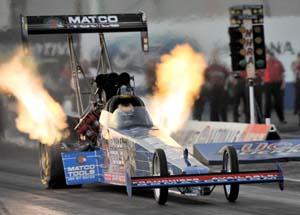
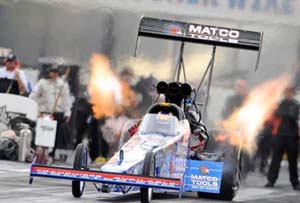
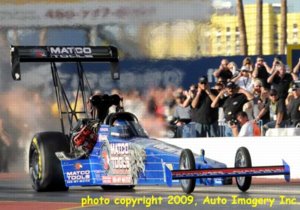
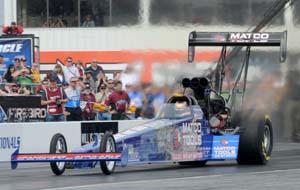
Antron, you have three wins in 26 Top Fuel races, which is pretty impressive, in the Matco Tools
dragster, including one win and a runner-up in the first two races this season. You have a
42-point lead over Brandon Bernstein after the first two races. Rewind maybe six weeks to the
middle of January when there was so much turmoil going on with the change in ownership and crew
chiefs, could you have imagined this? Bring us up to speed now, if you thought this was possible.
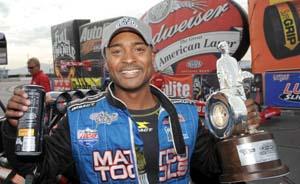
Antron Brown
|
ANTRON BROWN: Actually, it didn't take me by surprise. When we go back six weeks ago, it's
just like we were thumbing along, everything was great, like a gravy train over here at the time
with 3BRacing. The whole team had the car ready to go, set forth. We were getting ready for the
upcoming test session at Phoenix, Arizona. Then we had the bomb dropped on us. We didn't know if
we had a team owner, where my team owner (David Powers) basically told us he was getting out of the
sport, he couldn't do it because of health reasons. We were a little bit in turmoil.
Later that afternoon, actually my team manager now, Tom, walks in the building and tells us that
Mike Ashley took over the race team. At the time we found out that Lee Beard was going to be my
crew chief. I was like, 'Oh, Lord, what's happening? Where are we going with all this?' They told
us that Brian Corradi and Mike Oswald was going to be our crew chiefs. I knew we had two solid
crew chiefs coming in. Made me feel better. But I was worried about my team getting separated.
Our team as a whole came together. They kept the majority of all the guys on our team. A couple
of guys didn't want to stay. They were actually getting out of racing.
We went to Phoenix, and that's when our whole deal came together. The whole team jelled together
well. We went out there and ran the quickest in Top Fuel. Gave me a boost of confidence to know
what our team was capable of, all our hard work in the off-season paid off. Went to Pomona,
qualified No. 1, went to the final. I was ecstatic, pumped up.
We pulled the win there in Phoenix. Gave me a continuing boost of confidence. We're a contender
in the championship. We didn't know how our team was going to jell. I'm pretty stoked now because
I know we have a strong team and we're only going to get stronger as the year goes on.
Ron Capps
|
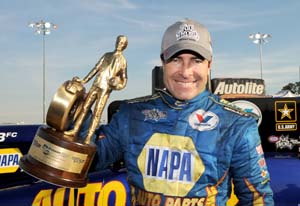
MICHAEL PADIAN: I'd like to introduce the points leader in Funny Car, Ron Capps. Ron has won
the first two races of the 2009 season, to give him 26 Funny Car wins for his career, which ties
him for top five for all time with Cruz Pedregon. He has 27 total wins, of course, with the one
win in Top Fuel.
Ron Capps is the winningest Funny Car driver in NHRA history to have not won a championship. He
has three second-place finishes: 1998, 2000, 2005.
Ron, I think it's fair to say you are among, if not the most, decorated driver to not win a
championship. Crew chief Ace McCulloch is in the same boat. What's difference so far this season,
the first two races, than last season (when you didn't win a race)? Where do you think it's going
to take you 22 races from now (end of the season)?
RON CAPPS: Well, pretty much just the approach for this season from the get-go. I mean, when
we left Pomona last year in '08, we ran the quickest run on Sunday and lost in the final. We ran
4.07 or 4.08, one of our quicker runs for the year. By a lot of team standards, we had a pretty
good year. For our standards last year, we were kind of embarrassed with ourselves with how we
finished. We finished eighth. We didn't win a race. We were in final rounds. We didn't live up
to our expectations.
At the end of the day, of course Don Schumacher, NAPA being our sponsors there, they want us to
win. But it's Ace and I and the team that have to wake up in the morning and know we're not having
the kind of year we wanted to have.
When we left Pomona, even though we ran good, he completely re-did the tune-up on the car, went
back to basics, and started from scratch, redid the whole car. When we showed up in West Palm for
our first test session, we were the quickest car every session. Then when we went to Phoenix for
pre-season testing, we wanted to test a lot of things. When we rolled into Pomona, we were a
little bit apprehensive but a little bit confident. We weren't sure how the weekend was going to
go. To win there, it just proved that a lot of hard work paid off.
Ron Capps
|
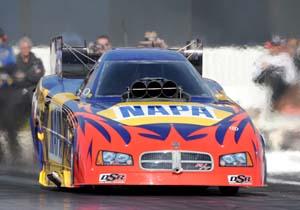
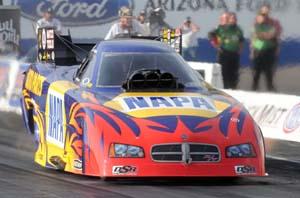
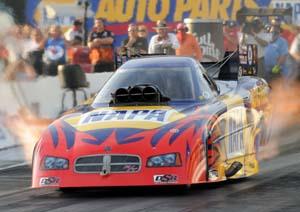
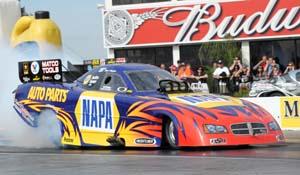
MICHAEL PADIAN: Ron, of course, drives the NAPA Dodge Charger.
I'll open it up to questions now.
Q. How different is Gainesville going to be compared to where you've been? What does it take
to win there?
ANTRON BROWN: I think the deal with Gainesville is when you go there, we know you can actually
set some fast ETs depending on the weather. It should be pretty cool out there. It's a sea level
track. The traction is always really good there. The fan atmosphere really gets you pumped up.
It's a really good track to go fast at.
It's going to be a little bit different coming from Phoenix in one aspect because Phoenix was dry,
it was fast out in Phoenix. We're going to have a little bit more humidity. Play mind games on
the crew chiefs. Set their tune-ups in a different way. Us as drivers, I mean, we personally -- I
get pumped up going to Gainesville because it's where I always started my season off before and the
weather's always right. It's always one of the biggest races we go to.
You have to deal with the crowd. You got to deal with all the other stuff going on around you and
get ready for a real fast race.
MICHAEL PADIAN: Having won there in 2006 and 2007, Ron, your approach?
RON CAPPS: Like Antron said, the conditions can be very good. One thing we learned, lucky
enough to win it there twice, those years, it's real easy because of the records set there in the
past. Kenny Bernstein being the King of Speed, breaking the 300-mile-an-hour barrier. The track
had cool conditions with cloud cover for several years and got a reputation for being very fast.
But as of late, with being in March, the sun can come out. Of course, humidity, a lot of these
crew chiefs have in the back of their mind this attitude that this track has had records set there
and you need to get after it. But it's very tricky.
Antron Brown
|
Antron will tell you, when the sun comes out there, you can't try to run low ET. The crew chiefs
that do it are the ones that may qualify low qualifier but they're going to go to go out on race
day because conditions change.
It's a very tricky track, like Antron says, but it's prestigious. The first year I won, I was
blown away, because that race, it's one of the big three races we have. To win it twice was even
bigger.
It's kind of like the Winternationals for the East Coast. A lot of corporate sponsors come out.
It's a big deal for everybody.
Q. How do you rank the Gatornationals as far as all the races on the Florida? Is it what you
would consider one of the most prestigious stops? And how has the economy affected your programs?
RON CAPPS: Well, as far as ranking the race, kind of go off of history. I love the sport of
drag racing, following the history as a kid. It's probably the second biggest race. Of course,
Indy has to be our biggest race. For me Pomona is big because of its history and being the heart
of drag racing. Wally Parks got everything started there.
When you look at the corporate level, you look at the fan turnout, the campers, when you're driving
up that small highway to the racetrack, there's just miles of campers lined up with racing banners,
it's amazing.
So I would put it up there right with Pomona, two or three.
The economy, I'll tell you, I've been bragging on our sport because, to be honest with you, the fan
turnout has been unbelievable. We have a great package. Our sport is in good hands. The fact
that people are going to look in their wallets and say, Here is what I'm going to spend my money on
this whole year for entertainment. When you look at any motorsport, any stick-and-ball sport, you
can't get any better buy than a drag race. Take the kids, meet the drivers, meet the legends.
It's amazing to see the turnout we had. Even when it was raining in Pomona, I couldn't believe the
fans out there, even without umbrellas.
I expect a huge crowd in Gainesville. My sponsor NAPA is doing just fine. I think people are
spending money on things they have at home instead of going out and buying a lot of things. I'm
not really that worried about our sport.
MICHAEL PADIAN: Antron, first of all, the Gatornationals, what is your perspective on it?
ANTRON BROWN: The Gators is, definitely like Ron was talking about, one of the most
prestigious races, especially for the bike class, because it's where the bikes always started at.
That's my start back in '98. I mean, I love going to the racetrack. I'll say it, it ranks up
there definitely of all the races we go there, definitely in the top five of all the racetracks
that we go to, for sure.
When everybody thinks about racing, they think about the Gatornationals and the U.S. Nationals.
They go hand-in-hand with each other.
As far as the economy will go, I think our sport is just like Ron was stating, it's not just us
being biased because we're drag racers, when you talk to our NASCAR counterparts, they say the same
thing about our sport. It's the best bang for the buck. A few of them even came by thinking about
getting drag race teams because they see how our sport is growing, from the Coca-Cola standpoint
all the way down to when I look at it through our sponsor, with Matco. Their business is growing.
You see other people getting out of different motorsports, where they're taking a leap of faith and
more and actually extended our contract through 2009 and 2010.
It's definitely a great buy because you're seeing more people working on their stuff at home, like
Ron says. They're going to NAPA to buy their stuff and hopefully they're using Matco Tools to put
that on their car. Every child that gets in our sport now is under 12. Our sport is really family
oriented. The people come into the stands, come to the pit areas, mingle around, seeing the cars
warming up, seeing the crew. Every ticket is a pit pass. Our sport is growing in a time of
hardship, which is great for our sport. I'm happy to see it because people are having short
fields. We've been having 22-car fields in Top Fuel. The same thing in Funny Car. That really
put a shine on my face when we came out the beginning of this year. People were saying, Let's see
how the field is going to look. Our field has actually been booming with the new kids, rookies
coming out in our class and making our sport grow. I'm really excited about our sport as a whole,
how it's grown in a time of desperate needs. And I love Gainesville.
Q. What do you think of the new variable timing starting tree? How is it changing your
approach at the start of a run?
ANTRON BROWN: I love it. I never even realized it or even saw it. But I guess you did have
some people who've been in our sport for a while. Ron can probably talk a lot better than I have
because he's been in the Fuel class a lot longer than I have. I didn't realize there were some
people anticipating the tree, but you're seeing more of it as the race goes on. It makes it more
competitive for our classes. Now you have to be a disciplined driver, which me coming from bikes,
we always left when I saw yellow, I was able to red light. But I leave when I see yellow in Fuel,
I don't have to worry about red lighting. Other people were anticipating a little bit.
It's made our class a little bit more interesting because now people have to be more prone to be
disciplined enough to leave when they see yellow. I think it's been making a little bit for
up-and-down racing and better racing.
What do you think about it, Ron?
RON CAPPS: Yeah, I agree. It's something all of us drivers together last year and kind of
formed a group, sort of a task force to look at safety and a lot of issues to deal with PRO, NHRA.
One of the deals came up to getting the Christmas tree back where it was when the late Buster Couch
was the starter. It's so automated now. For people that don't know much about the tree, the
amount of time when a flash of yellow would come down when both cars were staged, a guy could count
one thousand one, one thousand two, almost guess at the light. We wanted to put it back into the
driver, make the driver a little more important I guess.
It caught the drivers by surprise. I almost red lit. Robert Hight told me the same. Raced the
semis in Pomona. We were more excited about how the tree made us wait, we were both in the cars
ready to push the gas, than even the fact I won, I was going to the final. So I think it was
welcomed.
We had a meeting with all the drivers. It was a unanimous decision at the time. I think you're
going to see one more change to the tree that NHRA might change, a small amount, nobody is going to
notice. Again, it's going to bring the drivers back into it. It needs to reward guys like Antron,
the guys that are really quick, that can wait and anticipate and leave on yellow. That's what
needs to happen. There were too many guys taking shots and guesses. That's not good when you come
home to your kid and you explain a loss because a guy guessed at a tree. Trying to eliminate that.
Q. There have been more red lights in the first two races than last year. Do you think we'll
see more reds all year long?
RON CAPPS: Yeah, you might. You might. But you got to take a step back before you go
forward. I think if there's any drivers complaining, then they need to go back and practice some
more.
I'm saying that because I could very well red light the next race. But the fact is we did it as a
group because we wanted to bring the driver back into it more. You might see some more red lights.
Antron can talk about the bikes a few years ago. There were a lot of red lights when they tried to
change the tree or they did change the tree. We've coped with a lot of changes with NHRA. They
went to a different bulb type. A lot of things have happened in the past. It went along until all
of a sudden the tree was just more of a robot.
There was a guy named Buster Couch, a starter years ago. It was in his control. You didn't leave
until you saw amber. If he wanted to make you wait, you waited. That's when you hear Don
Prudhomme and Don Schumacher talk about the old days. That needs to be back the way it was.
Q. When you look at how competitive it is out there, how remarkable is it that Tony Schumacher
had last year with all those wins? What could you compare it to maybe?
ANTRON BROWN: Compare it to? That was kind of phenomenal. He had an unbelievable team. I
had firsthand watch at it because he was kind of kicking our team's butt up and down the track each
and every time last year. I think we beat him twice maybe. No, once. I was 1-6 against him.
When you can compare that to? One of the John Force's domination years, when he won all those
world championships in Funny Car. I think some people say, is that good for the sport. I think
it's great for the sport because what it has done is I think if you see Top Fuel now, it has raised
the level of Top Fuel because everybody has to compete with that kind of team. That team is still
out there with Larry Dixon, who is a phenomenal driver himself. Us as a whole, we worked on the
off-season so we can be that much more competitive. That's what it does, it drives it.
Force won all those championships. I'll let Ron speak about that. I think that rose the level of
Funny Car to where it's at, too. All it does, when one person breaks records, it creates a whole
'nother level for the teams to have to step up to to compete on that level to win that
championship. What it's done is you create your own monster with other race teams to step up to
that level. That's what's happening.
MICHAEL PADIAN: Did John have any seasons that paralleled that at all, Ron?
RON CAPPS: Oh, yeah. When I first started, that's the reason I went to Funny Car. I drove
Top Fuel for a year and a half. A lot of teams, that's the reason you see a lot of Funny Cars
where they're at right now. Everybody wanted to go in and battle John Force. He was the guy you
wanted to put yourself against because you knew he was absolutely the best. He was destroying
people. He was clinching championships sometimes in September.
Yeah, I've seen that before firsthand. Being a teammate of Schumacher, watching what they've done
the last few years, I'm not sure you'll see that again in some time. It was an amazing thing to
watch. Everything was going right. So we'll see.
MICHAEL PADIAN: As a footnote, Tony did set the record in either nitro class for most wins
in a season. He had 15. John Force had 13 in 1996. Greg Anderson in 2004 had 15 wins and 76
round wins, which Tony Schumacher had also. They both share the NHRA record for wins and round
wins at 15 and 76.
Q. Ron, you referred to last season being embarrassing for your team. Yet in the last race of
the season, you made the finals. Did that give you a boost of confidence coming into this year?
RON CAPPS: Yeah, well, definitely. Ace that whole day Sunday in Pomona at the end of the
year, I could see it in his eye. He was trying things he wasn't comfortable trying, but that's
what you got to do a lot as a crew chief. I could tell on the car, the car was getting much more
of an animal every run. In the final round, he did some things he would not normally do and it
paid off.
I wanted to go hang myself after running what we did, finally running that good, be in the final
round, last race the year, a chance to give NAPA a win, losing the race. I had the whole
off-season to think about it every morning.
It gave us definitely a silver lining to look forward to this year. That's why we're so
apprehensive. When Ace decided to change a lot of things, it was like, We just finished with a
great run. He also knew that the other teams out there, (Auto Club Ford Mustang crew chief) Jimmy
(Prock)'s team that always seems to be low ET at qualifying, we were going to have to step it up.
To do that we were going to have to completely change everything.
As a crew chief, it's a hard thing to do. But I'm glad he did it.
Q. In Phoenix you destroyed the field. How did that feel after what you went through last
year?
RON CAPPS: Looking back, it kind of looked that way. When you're in the trenches race day, it
didn't feel that way. We barely beat our teammate Matt Hagan the second run. We weren't quickest
the first couple rounds, but Ace knew why. The cool thing about racing with Ace, you look at years
past. There's been great drivers in the past. But if you look at a great racer, there's only a
few of those out there. He's one of those guys that approaches it that way. He only ran what he
thought we needed to win those rounds, not get ourselves in trouble.
I didn't feel like we were dominating. What made me feel like maybe we had a car that did maybe
dominate a little bit was the final round when Mike Neff broke his clutch linkage. He idled down
the track (indiscernible).
MICHAEL PADIAN: Ron, we sort of lost you there. You broke up. As a footnote to what Ron
mentioned just a minute ago, in 1996 John won 13 races out of 19. In 2004, Greg won 15 of 23.
Then last year when Tony won his 15, we had 24 races.
Q. Antron, you've had success in both classes. Do you feel now you're kind of racing what you
always wanted to race? Is this kind of a dream being realized?
ANTRON BROWN: Oh, for sure. I mean, I can take you back to 1986. I was 10 years old at the
Summernationals at Old Bridge (Township Raceway) Park in Englishtown, New Jersey. I was there when
Big Daddy Don Garlits flipped his super shop car over. I remember as a kid just watching that
race. I was a motorcross racer back then. My dad was drag racers. They were Super Comp and Super
Gas racers. I remember I said, 'I want to drive one of those things one time, either a Top Fuel or
Funny Car.' Didn't make a difference. I was never picky. I was fascinated with the nitro class,
how fast they went.
I got into the motorcycle end of it. I got there and, Capps will remember, when I was over at DSR
racing the bikes, I would talk to him every once in a while. I want to drive one of these. Will
you help me out? Capps was one of my heroes. I thought he was the best in the business that ever
drove a Funny Car. He would say, Whatever you want, if you get in one of those deals, I will help
you drive it. I want to do this deal. I want to do this deal.
I just never got the opportunity to make it happen at DSR. When I got this opportunity to come
over here with the Matco car, I went full head of steam. Fortunately it worked out for me. I was
putting my head down. Till this day, when I won my first race in Houston, I still look up at the
sky every day and say, 'Lord, is this really happening?' I think I'm dreaming. It's like a dream
to drive one of those cars. Until you drive one and experience it, it's like a being kid in a
candy store, you want to do it over and over and over again. The ride never changes. That's why
Force is still doing it and he's (59 years old). He loves it. That's the kind of passion I have
for this sport as a whole and driving this racecar. I'm very fortunate to get to do what I'm doing
for sure.
Q. Ron, when you look at how you finished second in your career, are you at a point where
you're kind of compartmentalizing the season into segments, how you want to start off, things you
maybe want to try mid-season, trying to save it for the end, or are you pretty much going all out
all the way through?
RON CAPPS: That's kind of funny. The way we approach this season I think is kind of how I
want to approach the whole thing. In years past, everybody has had this Countdown looming over us.
You want to be one of the cars that makes it in there. When you get in there, you want to try to
be a car that's peaking.
The first year of the Countdown (2007), we went in with a points lead and we lost a huge points
lead when it started. We just never saw the points lead again.
The approach that Ace and our team have this year, where it's one run at a time. I know it's
cliche. We're standing on the gas and we're going to try to be the quickest car every single run
of that round, then do that and win every race, just try to win races. All that will come with it.
Instead of laying back and testing, trying things here, you know, sound like a NASCAR guy, We're
okay with a top-five finish this weekend. That turned out to not be the right approach. I think a
lot of teams are going to see that same thing. You can't approach it -- drag racing is not NASCAR,
first of all. But you can't approach it like that.
So far it's worked for what we wanted to try this year.
Q. Antron, talk a little bit about the difficulty or the transition between the motorcycles and
the Top Fuel car.
ANTRON BROWN: The transition was mind-boggling. A lot of people say it looked easy, but they
looked from the outside looking in.
When I first did the transition, I went to Frank Hawley Drag Racing School and got my alcohol
license. I got to Gainesville with the Matco team, was able to make four runs there because the
weather wasn't permitting. We went in the wintertime. I got my first shake, tire shake. When the
car shakes its tires, it's like somebody put your head between two two-by-fours and was slapping
your head like a paint shaker. It was kind of violent. It got me to all the different types of
feelings I'm going to have to get used to in the car. The bike, the movements are real subtle.
When I got into the Fuel car, everything was like overexaggerated where you know it was happening.
So I think the bike really got me primed and ready for how to be one with the vehicle because
you're not strapped in, you're sitting on top of it, where you have to feel every nook and cranny,
be in tune with it to give feedback to help the crew chief make the tune-up calls besides looking
at the race computer.
When I got into the Fuel car, all those movements were really exaggerated, where it really helped
me catch on quick. The thing the bike did not prepare for me was the rate of acceleration. That's
one thing that took me at least a half a year just to get into my system where I can actually say,
Okay, this would happen here. This would happen in the first 60 feet. This would happen at the
hundred-foot mark. This at the 330.
The Fuel cars, what happens is you feel about 3.8 Gs off the starting line. When you get to
hundred foot, it goes to 4.2 Gs. 330, you're at four and a half Gs. When you're at a half track,
you reach 5 Gs. On my bike, I felt 3.8 Gs off the starting line till about a hundred foot out,
then it descended where it went down to 1 G by half track. You're along for the ride. You got the
bike straight, it's easy. The fuel car is accelerating all the way down the racetrack. The whole
racetrack is like my Pro Stock bike 60 foot. In three seconds, we're over 300 miles an hour.
That took me some really getting used to, how to feel the car, get it through tire shake, keep the
car in the groove. When I first started off, I was looking at it all the way down the racetrack.
When I was looking at all the way down the racetrack, the car would get out of the groove and I
would spin the tires, where I had to start paying attention to a hundred foot or 200 foot in front
of the racecar. If the car was making a twitch, I had to correct it. It came to just be a
reaction. When I was trying to do it, I never could keep up with it. I just had to react to it.
The adjustment took me a while. I'm still learning stuff to this day. I'm way more comfortable
than what I used to be. I can maybe win a round or two if I have to pedal it before last year
where I had to get through it and I might lose a round because I didn't pedal it at the right time.
I think now I can maybe sneak a couple rounds out if I have to get into a pedals match with
somebody else.
Q. Ron, is this the strongest start you've ever had to a season in your competition? What's
the highest number of consecutive race wins you've been able to string together?
RON CAPPS: Definitely the strongest. We had a pretty good start I think it was '05, but
nothing like this. The most consecutive, I'm not sure. I know we've won at least two in a row. I
thought we won three in a row a couple years ago. Trying to remember. Michael might know more.
Yeah, this is definitely our strongest. I think our consecutive might be three.
Q. Antron, in NASCAR the open-wheel guys that have made the transition, AJ Allmendinger, Ricky
Carmichael, those are exceptions. Most of the open-wheel guys did not make it. What do you think
you share with those guys that you're able to adapt and be a points leader?
ANTRON BROWN: I think for one thing I can relate to Ricky Carmichael a lot. I think one thing
of it is is just having the determination and the willingness to want to win. I think that's what
you see not in just athletes, but into your championship-caliber athletes. You know what I mean?
You just go out and beyond the call of duty.
When I took the Top Fuel deal, it didn't just come to me. It's that a lot of people say, You
picked a bike guy to drive a Top Fuel car? You did this or that. For me personally, when I get in
there, I kept my head down, worked hard. I've been in the shop every day. Scott Speed, Ricky
Carmichael, that's what they shared, they did it in their other previous sports. That's why they
got to get into the NASCAR Truck Series, what they're doing, they actually do everything it needed
to take and more. They went beyond the realm to achieve success. Success doesn't come easy. You
go through bumps and trials. But it's the people that don't give up, continue the work ethic to
succeed. That's what makes champions, how you go through adverse times.
I'm one of those types of people. I don't like losing by any means. I'm confident in myself. But
I'm willing to put the work that it takes to be successful in life. That's the main key, to have
determination.
Q. During the off-season you got the opportunity to race those guys in a go-kart in Orlando.
Could you comment on that?
ANTRON BROWN: It didn't go the way I wanted to. I went out there, got my tail whipped. That
time right there, I'm not giving up, I'm going to go out there with them next year, but be with a
little bit different team next year. I had a lot of equipment failure. It didn't help when I had
- what do you call it - a pair of vice grips that were still clamped on my steering column beating
me on the leg when I was going around the track either. It was a lot of fun. You could see the
raw determination of those guys, how they got out there from their sports. They performed well in
the go-karts. I love go carts to death. Ron was out there with me. It's a lot of fun, but you
got to be on your toes. That's a lot of endurance. I'm going to be ready for them next year.
Want to go out there and try to get definitely a top-10 finish. That will make me feel real good
for a drag racer.
Q. How do you think the one thousand foot length is working? Is there a possibility of going
back to a quarter mile?
RON CAPPS: I'm real happy with it right now. Until we get all the shutdown areas at all the
tracks like we have at Pomona, Charlotte and Indy, you know, then I think we'll be more comfortable
going a quarter mile.
I don't think we've lost any bit of the competition, the racing, for the fans. I think a lot of
them had their arms up in the air when it first happened, were wondering if the racing was going to
suffer. It's still strange not to go to a quarter mile. I think a lot of us have gotten more used
to it.
For me personally, I think it's a good thing right now. I see us going back to quarter mile
sometime down the road.
ANTRON BROWN: I definitely agree with Ron on that. To give you a little history, in
previous tracks, some of the tracks haven't changed since the '60s and '70s, some of the early '80s
deals. Our cars do over 330 miles an hour in a quarter mile. I think it's all the right moves we
did, especially with our sport. The racing actually has gotten tighter at a thousand foot. We all
loved 1320. Don't get none of us wrong. We want to go back to the full quarter mile. That's what
our sport was built on. In the fan aspect, you're seeing a lot of cars and teams where the part
attrition is up when you can see the cars run hard to a thousand foot without hitting the rev
limiter. I think you're going to see 315 miles an hour or 310 miles an hour out of a Funny Car,
you're going to see 320 out of a Top Fuel dragster. I think you're going to see some good quality
racing this year. I'm pretty excited about it actually because now it puts it back into a driver's
hands a little bit more because you got to be more in tune and crisp off the line to get those race
wins.
MICHAEL PADIAN: Thank you for joining us on today's call. 2007, Ron Capps won three of the
first seven races en route for a fourth-place finish. In 2006 he won five of the first 11 races,
en route to an eventual third-place finish.
Thank you all for joining us and a special thanks to Ron and Antron for taking time out to join us.
We'll see you next weekend at the 40th annual AC Delco NHRA Gatornationals.