


 |
 |
 |
 |

|
 |

 |
 |
 |
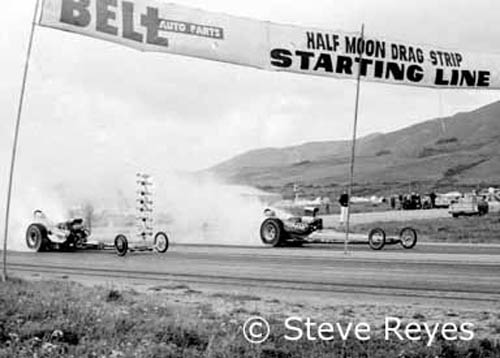
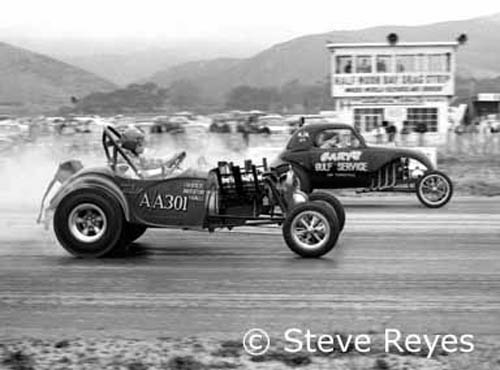
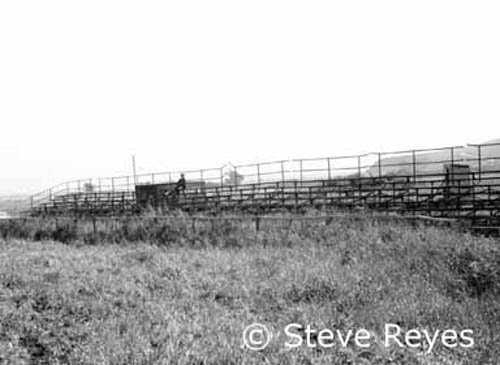
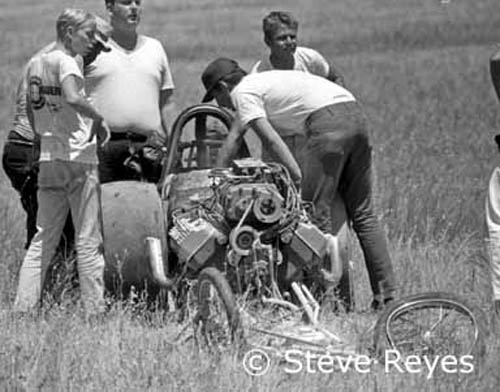
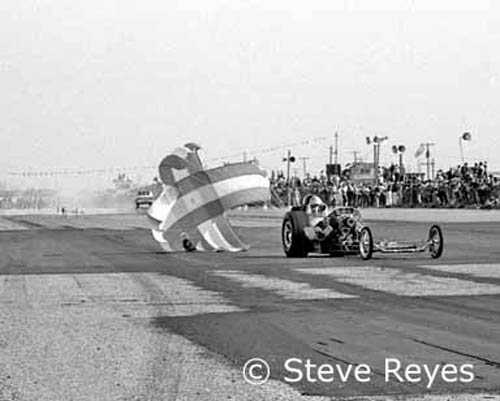
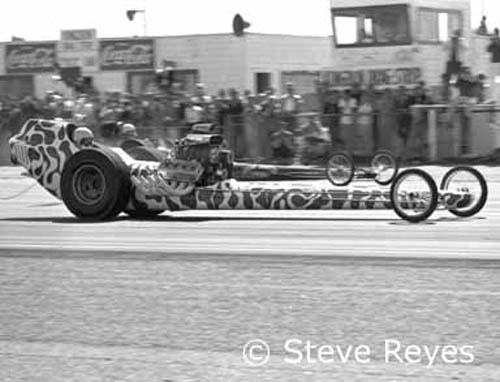
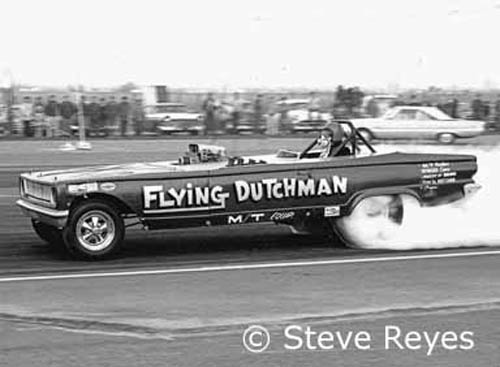
In the last segment on dragstrips, we featured the Fremont and Sears Point dragstrips. A big contrast from the newly opened Sears Point operation was the former airport turned dragstrip located in Half Moon Bay, California. This race track/airport runway was just south of San Francisco along the coastal highway, just a stone's throw from the Pacific Ocean. When I went there, the place was run by the owners of Champion Speed Shop based in San Francisco. They raced off and on at HMB with about two or three big shows a year. As the track was an old runway, it was not the smoothest racing surface. Also, the quicker and faster the top fuel dragsters ran, the shorter the stopping area became at Half Moon Bay. If a faster race car had a chute fail to deploy, they were in serious trouble. For example, Bob Haines almost drowned in a culvert full of water at the end of the track while at the controls of the M&R Special AA/FD. Denny Milani wasn't as lucky as Haines. A chute failure and Milani took the Gotelli/Milani AA/FD off the side of the shut-down area into a culvert and he died instantly in the ensuing crash. Another airport runway converted into a race track was Kingdon raceway in Lodi, California. Kingdon was a wide-open race track with the whole area paved. Since the entire area was paved, there were no trees, hence no shade. In the summer with the temperature rising to 100 degrees plus, any shade was a gift or man-made. I photographed in the winter (January 1st) and in the summer at Kingdon. This one track had the lowest temperature (37 °) and the highest (120 °) The final track in this segment was located on the outskirts of California's capitol city of Sacramento. I first attended the races at Sacramento Raceway in 1965. I believe the event was called The California Championships and it featured many a well-known name in NorCal and SoCal top fuel racing. When I became NHRA's Division 7 photographer, Sacramento was a regular stop for me. The track surface seemed okay but the pit area and spectator areas were dusty and dirty from a lack of paving. They would use a large water truck spraying water to keep the dust down. Over the years, the track has undergone vast improvements and still operates regularly to this day. If you wish to purchase prints of the photos below or any others, they may be obtained by contacting us at breyes@reyesontour.com. Other photos for purchase may be viewed by following the links at www.reyesontour.com.
left a lot to be desired. Yes, it was a challenge for any top fuel car to stop safely but they did. The track always had some great altereds and surprise gas coupes from Los Angeles to add to the mix of racers.
could be seen chasing each other on the grandstand seating area. I brought LA photographer Tim Marshall for his first visit here and he could not believe the condition of the track.
California, in 1968. Sacramento was hosting the Drag Strip Magazine Championships and I was hired to shoot it for them. Again, the drag strip area at Sacramento was huge. The track was next to the Air Force base so noise was not an issue. In 1969, Bob Mayer and the Speedmasters AA/FD found out how big the race track area was when he got a face full of oil and went off-roading. In 1970, guardrails were placed to keep wandering cars on the track. As you see, looking down, Charlie Wilson's funny car in 1968, it was wide open spaces at Sacramento Raceway.
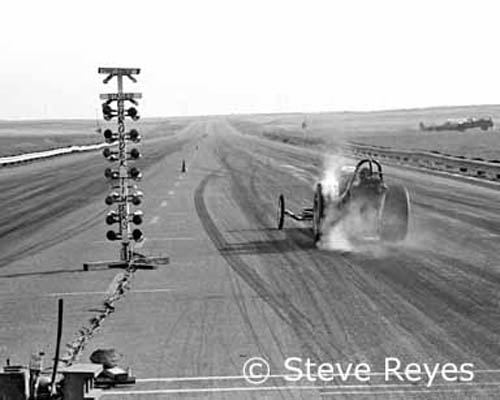
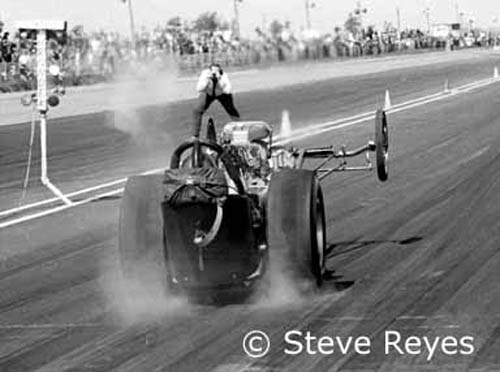
This one was all pavement though. Kingdon had a pretty good bite, just look at Roy Dunn and his AA/FD. Take notice of the starting system which was a kind of mini-tree built on plumber's pipe. The shut off area seemed like ten miles from the starting line. If you couldn't stop here, then you were a very bad race car driver.
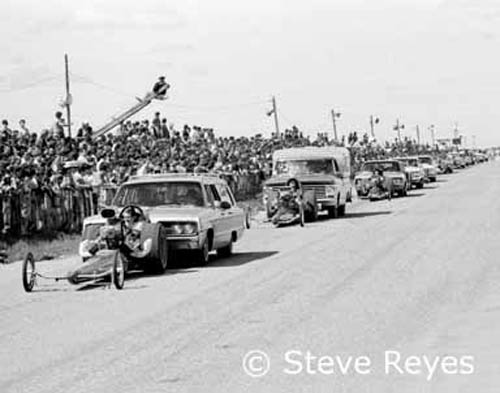
provided shade on those 100 plus degree race days. Alas, both buildings were victims of arson, the last being the tower in 2009. For some reason, top fuel seemed to be king at this track. Yes, funny cars came and raced, but for the Lodi fans, top fuel was the end all. At this 1967 Lodi, top fuel parade, the first car was Mike Snively in the Hawaiian, the second car was Tom Hoover and his AA/FD, and the third car was Marin Schwartz in his Anaconda AA/FD. Lodi had no problem attracting the best in the AA/FD class.
|
|




Ready to take your order at 1-800-230-3030 | Customer Service 1-800-517-1035