


 |
 |
 |
 |

|
 |

 |
 |
 |
After qualifying tenth in Top Sportsman at the IHRA World Nationals in Norwalk, Ohio, Jim Laurita loads his Tim McAmis-built '63 Corvette into the trailer for the night. It's a balmy Friday night in August, 2006; eliminations start early tomorrow morning, but with no maintenance or repairs to perform on the car, the Morgantown, West Virginia coal mining executive and his volunteer crew have some time on their hands and elect to take a stroll through the pits before calling it a night.
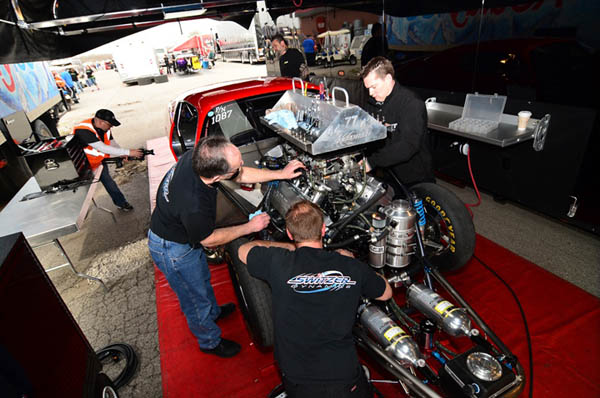
Laurita and his friend take a particular interest in the work going on in Billy Harper's camp. It's approaching 1 AM, and Harper's crew is thrashing on his nitrous-powered 2000 Viper. The team is pushing the limits of the nitrous tune-up each time down the track in an effort to qualify, requiring them to tear down the engine every two runs to check for damage and make repairs as necessary.
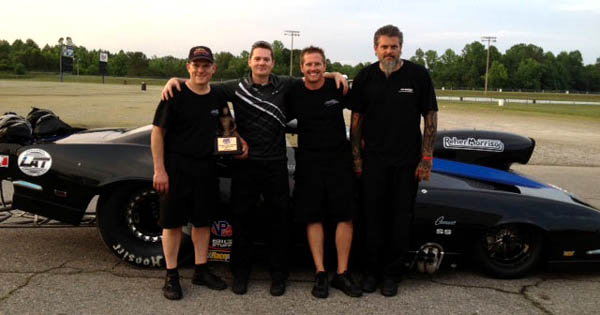
Just four years later, Laurita is again loading his car into the trailer after a day at Norwalk. Only this time, it's a '70 Camaro, and he's just scored his first race win in Pro Nitrous, the nitrous-only descendant of Pro Modified. "Here we were, doing the exact thing I said I'd never do," said Laurita. "I'm running Pro Nitrous, and we're pulling the motor down every night to check things out whether we hurt it or not."
"Drag racing is a love. I'm an engineer at heart and really enjoy the mechanical aspect of the sport," Laurita said from his office in Morgantown. "I'm an executive of a coal company now, and though I have a mechanical background, I don't work with my hands anymore. I'm typically in front of a computer working with spreadsheets or I'm in meetings or on the phone all day, so drag racing has become my engineering and mechanical outlet."
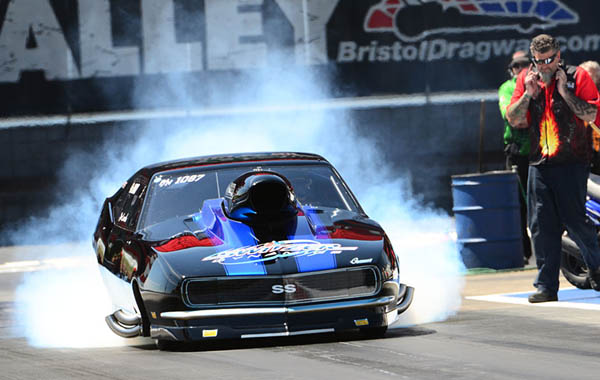
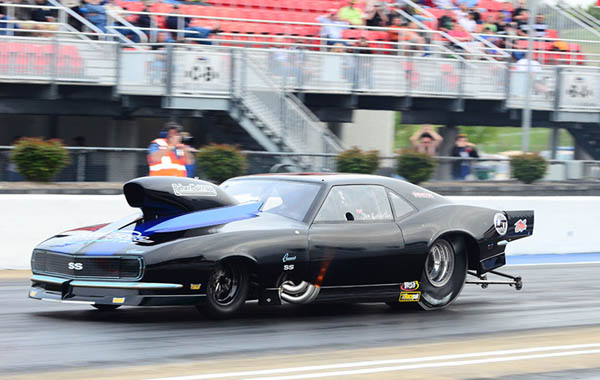
"I went to a couple races with Teddy and I was hooked. I really wanted to do this," Laurita recalled. "I knew I wasn't getting any younger, so if I was going to do it, I had to do it now. I had McAmis build the '70 Camaro and I started running Pro Nitrous in 2009 and haven't looked back. "When I got that first win in 2010, it was just a bunch of us local guys figuring this whole thing out on our own," said Laurita. "We had run nitrous before, but had never tried to go this fast. We had no help. We learned chassis setup, gear ratios, engine tune-up, everything on our own. We evolved from 4.0s to low 3.90s, but when we tried to get into the 3.80s in 2011, we just couldn't get there. I realized I was going to need some technical help." Initially, Laurita approached nitrous mastermind Brandon Switzer for help on his engine combination and nitrous tune-up, but the relationship quickly evolved into much more, one that eventually saw Switzer overseeing the entire setup of Laurita's car. Teaming with Switzer paid immediate dividends and Laurita became a consistent 3.80 performer. When Switzer set out to form his own company, Switzer Dynamics, in 2012 and needed someone to test his new products and ideas, Laurita happily obliged. "Working with Brandon has been a perfect fit," said Laurita. "We think and work very similarly; we're both engineering types and are very analytical. It's been a great relationship." With the increasing complexity in successfully applying the power generated by a nitrous-guzzling, 872 cubic-inch Reher-Morrison engine, the approach employed by Laurita and Switzer is becoming more valuable each day. Pro Nitrous cars are among the most fickle beasts in the sport, and simply getting from point A to point B under power is no easy task. Pushing the envelope and trying to go quicker with a multitude of car, engine and driveline combinations can seem nearly impossible, but Laurita and Switzer have done just that. In 2012, Laurita purchased the Jerry Bickel-built '68 Camaro from Switzer that Khalid Al-Balooshi drove at the end of the previous season. He continued to race his '70 Camaro through the end of 2012 with the intention of bringing out the '68 Camaro in 2013. "I've always raced with an automatic, and with a torque converter," Laurita said. "The new car had a clutch setup, and Brandon wanted me to give it a try. I had never driven a race car with a clutch, so we did some testing and I got comfortable with it before we decided to take it to Bristol." Laurita went right to the top of the charts at the X-DRL Thunder Valley Madness in April, posting a career-best 3.785 and securing the top spot in Switzer Dynamics Pro Nitrous qualifying before rain ended the event. He followed that up with another pole at the Bash on the Bayou in Belle Rose and a semi-final finish in eliminations. Laurita's switch to using a clutch was also compounded by the fact that his car is the primary testbed for Switzer's new electronic fuel injection system and intake manifold design, but the team's performance hasn't skipped a beat. "Brandon, is young, hard-working, and brilliant," Laurita said. "When you put those three ingredients together, there's no telling how far he can go. We've already seen tremendous gains in the performance and ability to fine tune the EFI system. What I've seen so far in a short period of time has me extremely impressed. "Brandon is working on a lot of things to take his combination to a level people probably never expected. He feels like he's just scratched the surface." Switzer's desire to innovate and Laurita's willingness to experiment illustrate what it takes to be successful in the class today. In a world that has been dominated for years by cars with clutches and carburetors, the team isn't afraid to try new combinations. Very few, if any, Pro Nitrous racers have competed with an automatic, a clutch, carburetors, and electronic fuel injection; Laurita has in the span of one year. That satisfies his inner engineer, and it's what has him in prime position to be the first to break the 3.60-second barrier in Pro Nitrous. "I've always been a nitrous guy, so X-DRL Pro Nitrous is the top of the mountain for me," Laurita said. "I honestly never thought I'd be in this position, but I'm enjoying every second of it and can't wait to get to the next race, even if it does involve some late nights working on the motor."
|
|



Ready to take your order at 1-800-230-3030 | Customer Service 1-800-517-1035