


 |
 |
 |
 |

|
 |

 |
 |
 |
So this concept of an enclosed cockpit via canopy is not really new. It was tried in the 1950's, 1960's, 1970's and as recently as the 2000's. Canopies have primarily been a mainstay on land speed or Bonneville race cars. Drag Racers such as Mickey Thompson (1955 Panarama Special), Hank Vincent (1960 Top Banana), Nye Frank (1965 The Pulsator ), Tom McEwen (1967 Super Mustang ), Darrell Gwynn (1986 Budweiser Top Fuel), Gene Snow (1986 Snowman Top Fuel ), Jocko Johnson (Invader), The Jungle 4, The Logghe Brothers, Ed Roth and of course, Don Garlits, all have featured a "driver under glass" on various stream liner style dragsters. Even LSR star Craig Breedlove debuted a Top Fuel canopy equipped dragster at the Hot Rod Magazine Championships in 1964 but with no success. It was mainly Larry Bowers in the 1970's and then Don Garlits who showed that a canopy could work on a Top Fuel dragster. Now taking steps to improve the Garlits design is the Don Schumacher's Army Top Fuel team. With the blessing of NHRA, Schumacher introduced a slick canopied Top Fuel car in the middle of the 2012 season. Canopy or no canopy the Army Top Fuel car thunders down the track and it ended the 2012 season second in points. Is the canopy an advantage to Top Fuel racing? The 2013 season will no doubt feature other Top Fuel cars with canopies, however, for me, it isn't about the "bubble" of glass but the team and the driver that win races and championships. If you wish to purchase prints of the photos below, they may be obtained by contacting us at blrenterprise@cox.net. Other photos may be viewed by following the link at the bottom of the page at www.reyesontour.com.
at Fremont, California in 1965. Bob "Jocko" Johnson built his stream liner and debuted it in 1959 with Jim "Jazzy" Nelson at the controls. The sleek stream liner ran a 8.35 at Bakersfield in 1959 for an ET record. However, all was not coming up roses for Jocko's stream liner, it was damaged during a high speed run in the mid-1960's. Jocko parked the "hurt" car until he restarted it in 1987. It's current home is at Don Garlits Museum of Drag Racing in Ocala, Florida.
state of the art Glass Slipper dragster. The car was the first to combine streamlined fiberglass body, aluminum frame and an enclosed canopy. This photo was taken at the California Hot Rod Reunion in 1995. The Slipper made a few passes down the quarter mile before going to the Wally Parks/NHRA Museum for drag fans to enjoy.
debuted at the Hot Rod Magazine Championships in Riverside, California, that same year. The car only ran a few times and when it didn't have the success that Breedlove expected the car was parked. Show car King Carl Casper obtained the car and put it on his show car circuit. From there it went to Robert Peterson's car Museum in Hollywood, California. When the museum closed in 1983, Kalitta purchased it and donated it to his long time friend Don Garlits and there it sits in the Don Garlits Museum of Drag Racing in Ocala, Florida.
Some would consider it to be one of the best examples of a streamlined dragster. The body is fiberglass with magnesium added to the inner body panels for strength. The body sits on a 136 inch wheel base with a nitro burning 327 injected Chevy for power. The car weighed an amazing 990 pounds. The car had three different drivers, Jim Marsh, Roy Steffey, and Maynard Rupp. The car proved to be very ill-handling due to the body design. It did clock 8:10 at 186 mph before it was parked. Don Garlits purchased it from the Logghe Brothers in 1987 and restored it to race ready and it now sits in his museum.
car in late 1964. The Jocko Johnson body rested on a Woody Gilmore chassis with George Cerny, Jr., applying the beautiful paint. Driver "Jungle" Larry Faust had his hands full while testing at Lions and San Fernando. The Southern California winds really affected the handling of the car and it took out the timing lights damaging the nose of the body. The team did not have the finances to test so the body and canopy were removed and the team returned to a conventional dragster style body.
in the mid-1960's with Connie Swingle at the shakedown controls. George "The Bushmaster" Schreiber took over as Roth's permanent choice as a driver when Connie returned to Florida. The car had a fully enclosed canopied cockpit when it arrived at the Winternationals in Pomona, California in 1967. However, Roth was told by NHRA officials he could not have a canopy so the Bushmaster quickly got our a saw and fixed the problem so the 'Fang could compete.
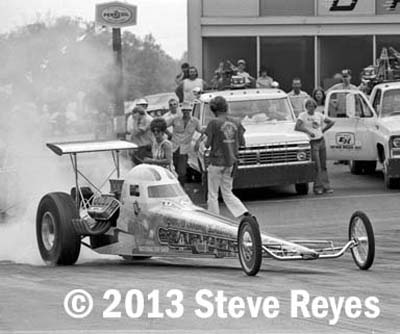
When he wasn't blowing the clutch or engine out of his car, he ran very well in the the California Top Fuel wars of the early 1970's. Bowers car was featured on the cover of quite a few magazines and was used by Doug Kruse to promote one of his PDA races at OCIR.
The East Coast based husband and wife team put together a one of a kind Top Fuel car called the American Way. It was a beautiful show and go race car built around their driver "Super Jew" Al Friedman. Friedman was very small so the cockpit was too small for any other driver. Just as the car was finished Al Friedman tragically passed away from a brain aneurysm. Now with a driver-less car the Lehman's searched for a driver who might fit the tight driver's quarters. West Coast Fuel Altered pilot Howard Haight tried to fill the seat and drove a few times for the East Coast couple. However, Lehman's never did find a permanent driver and soon had to park the car.
coolest Top Fuel cars on the race track that following year. Their Kentucky Moonshiner Top Fuel car sported a canopy that would cover driver Dale Funk on those quick high speed runs down the quarter mile. After a couple of runs, driver Dale Funk decided he hated the canopy so he removed the said canopy and again had the race track air in his helmeted face.
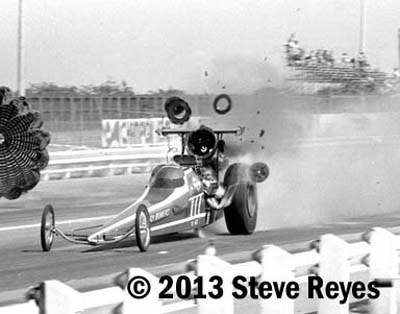
and T.C. Lemons built the car and Jocko Johnson built the stream liner body. Butch Maas piloted the car on its West Coast debut at Orange County International Raceway in 1973. Maas would record a 185 mph 7 second pass that evening but handling problems and engine failure put the car in the trailer. Then when the car returned to Florida Garlits jumped in and drove it to a 167 mph while the car went air borne. Garlits brought the car home in one piece and some modifications were done to help with the handling, etc. It was then Don "Mad Dog" Cook's turn to pilot the 'liner but the car still wanted to crash. Garlits retired the evil car and it was soon sold to rocket car driver Russell Mendez. After Mendez was killed, his partner Ramon Alvarez returned the car to Garlits.
August of 1987. Garlits did run 5.51 at 215 mph, upside down, backwards, and on fire. It was low ET of the event.
After the 1995 season the car was parked until 2002 when it was updated and readied to race. Garlits drove his SR 34 to a best of 323.04 in 2003. Swamp Rat 34 has a canopied cockpit, extra narrow rear end and the aerodynamic "T" tail section (mono wing). These three things make the car the most advance Top Fuel dragster to date.
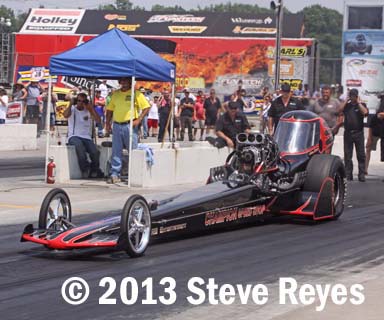
Champion Speed Shop. The Mike Fuller owned Top Fuel car was trying something different , a canopy. Driver Adam Sorokin complained that the canopy wouldn't clear of smoke or nitro fumes and he didn't care to drive in that fog. But hey, it looked cool!
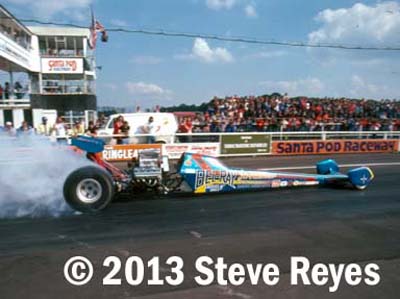
I ever saw with a canopy. An old Top Fuel car? I don't really know. Then while touring England with the Blue Max funny car in 1978, I came across the Bel-Ray Stream liner owned by Ashley and Cuss with Pat Cuss driving. The car ran alcohol and was a very popular car at Santa Pod.
|
|






Ready to take your order at 1-800-230-3030 | Customer Service 1-800-517-1035