


 |
 |
 |
 |

|
 |

 |
 |
 |
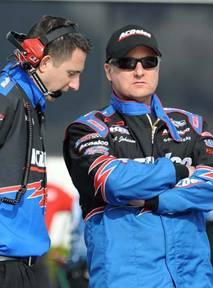
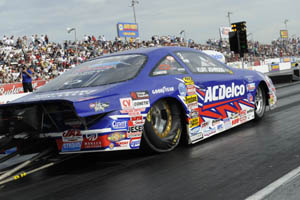
SUGAR HILL, Ga. -- Accurately tracking the weather can be the difference between winning and losing in NHRA Championship drag racing, especially in the closely competed Pro Stock category where the cars rely on a 500 cubic-inch naturally-aspirated engines for their source of power. The amount of horsepower created by these engines on any given day, at any exact location, or during any specific qualifying or eliminator session, is incumbent on the ambient atmospheric conditions. "We're constantly watching the weather," said Justin Belfance, crew chief on the ACDelco Chevrolet driven by Kurt Johnson. "Other than monitoring the track, that's how we tune our race car, and if you have a good race track, everything else depends on the weather."
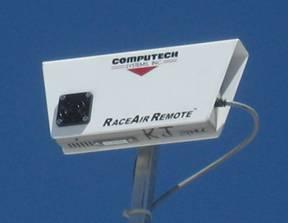
"Last year at Richmond, we had pretty good air, and the track was great," said Belfance. "All weekend we kept getting after it, and looking at how good the air was; it was making you want to detune the car because of all the power we were making. But the track was so good that we were soft all weekend, and we were much more aggressive with motor, transmission, everything, than we ever thought we would be." The ACDelco team looks at a number of different meteorological variables, and then plugs those numbers into a formula to arrive at an adjusted altitude and a correction-factor reading. "We look at temperature, humidity, barometer, all those things - how many grains of water are in the air," explained Belfance. "The motor does not want to burn water, and if there's a lot of moisture in the air, or the air is thick with water, the motor's not going to run clean. "The two things I look for, because it keeps it simple, keeps it quick and I can keep moving, is density altitude, but most importantly, I look at correction factor. The correction factor puts all the variables together and gives you a number. A perfect correction factor would be 1.000, therefore I know when I get out to the track in the morning and we have a 1.02 correction factor, we're going to have some pretty darn good steam." To monitor trackside weather conditions, the ACDelco team uses a sophisticated weather station from CompuTech that sits perched high in the corner on the outside of the transporter. Weather stations like these are visible on almost every transporter in the Pro pits and are as precise as anything used by your local television or radio broadcasters. More importantly, this weather station gives the ACDelco crew reliable meteorological information at that specific point on the globe. It has to be reliable. If it's off ever so slightly, calculations needed to set up the race car based on weather conditions will not be accurate, and that could be the difference between making the 16-car field during a tight qualifying session and heading home early.
Belfance also carries with him a small device the size of a pack of gum that receives updated information about every five minutes from the weather station. It can send vital information to the crew even if they are hundreds of yards away in the staging lane preparing for a run "The more the weather is changing, the more you keep an eye on it," Belfance said. "Like at Memphis a couple of years ago. It was close to 100 degrees outside and it was steamy, and then a cold front came through with a thunderstorm, and before you know it, it's 60 degrees and time to get our your sweatshirt. Those are the ones you really have to watch, when a system comes through. You can make some big mistakes on the starting line if you don't accommodate for those kinds of changes." Ignition timing, carburetors, transmission and rear-end gearing are some of the key areas on the ACDelco Chevrolet that have to be tweaked when the weather changes.
To stay informed and to make sure they have an even broader perspective of what's going on weather-wise, the ACDelco team takes a look at the Weather Channel before heading out to the track. "If there's a front 200 miles out that's moving in fast, it's imperative that we know about it," Belfance said. "I get updates from the Weather Channel on my cell phone, and I stay on top of it as much as I can, while at the same time watching our own instruments. We have to know what's going on, both at the race track and what could potentially be on the horizon." It's a phenomenon that probably isn't noticed very much by the average race fan whose attention while trackside may be focused elsewhere, but for the ACDelco crew and Pro Stock teams like theirs, it can be one of the most important factors in determining who wins, and who loses. "If you're just walking around you may not notice the subtle changes taking place with the weather," Belfance said. "When it's cool in the morning, it can fool you, and you can think it's good until you actually check it. Meteorology is a complex science, and out here, without our weather stations, we'd be lost."
|
|



Ready to take your order at 1-800-230-3030 | Customer Service 1-800-517-1035