


 |
 |
 |
 |

|
 |

 |
 |
 |
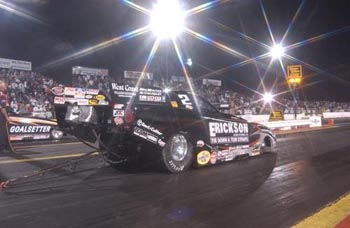
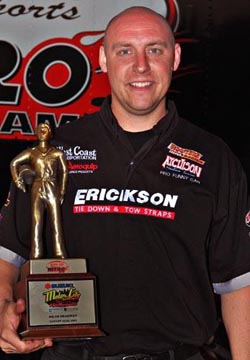
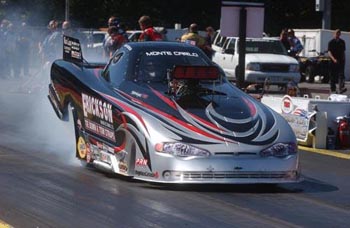
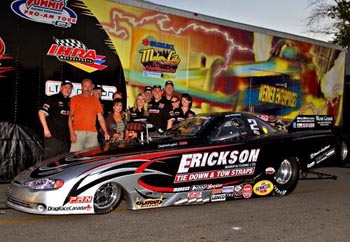
Not the kind of alcohol that comes in bottle or a keg, though he does admit to enjoying himself after racing in the lounge at Atco Raceway in New Jersey. Instead, he is talking about the type of alcohol that powers his Monte Carlo Alcohol Funny car during IHRA competition. >From the time he got interested in drag racing, the 32-year old Atchison knew that he wanted to run in the alcohol classes. "I've wanted to run alcohol all my life," he says. "All my heroes ran alcohol." Now, the three-time IHRA Alcohol Funny Car champion is right where he wants to be. "As an owner, I have no desire to do anything else," although, he says, he would always welcome the opportunity to drive other types of cars. Atchison says that one reason he prefers racing in the alcohol ranks is that he believes the competition is among the best in drag racing. "When a true fan wants to see good races, they are going to see them in Pro Stock, Pro Mod or alcohol funny car," Atchison says. "Nitro funny cars rarely run side-by-side." At the same time, he explains, alcohol funny cars are more economical to run than their nitro-fueled cousins.
That means that funding and sponsorship requirements are much lower in the alcohol classes, while the racing is just as good, if not better, he says. "You can get sponsors who can give you x amount of dollars and you can run in the alcohol classes," Atchison explains. "That wouldn't make a dent in a fuel budget." If that weren't enough, Atchison says that alcohol funny cars can be a better choice for racing teams that are made up of people who work during the week, rather than professional team members. While many fuel funny car teams has full time crew members, teams such as his, says Atchison, depend on crew members who work during the week and give up their weekends and vacation days to help out at the track. Alcohol cars, he explains, do not require the high levels of maintenance as do fuel cars. "You can treat it like a Pro Stock car," Atchison says. "You can keep it running and tuned and not destroy it on every run. I've seen a fuel car after a perfect run. I've seen the destruction." While many people have applauded IHRA's decision to add fuel funny cars to its national events, Atchison says he does not think it was a necessary move. "As a Canadian, I didn't see where they (nitro funny cars) were going to bring in more fans," he says. "The Canadian races always have large crowds." The three IHRA races in Canada are in Grand Bend, Ontario; Edmonton, Alberta and Cayuga, Ontario.
Rather than travel, the biggest problem to being based in Canada was the poor exchange rate during the 1990s and first half of the 2000s, Atchison says. "Initially, financially it was a struggle because the Canadian dollar was weak," he says. But, he says, dealing with the problems of being based in Ontario is something that he just has to deal with if he wants to be part of IHRA drag racing. "It's like walking uphill to get to school," Atchison explains. "It's something you have to do. You realize you're going to have to drive a little farther to do some testing." Like many men who grew up in Ontario, Canada, Atchison is a hockey fan and a fan of the Toronto Maple Leafs. But unlike most people from Ontario, Atchison is also a fan of the Philadelphia Eagles of the National Football League. "I've been an Eagles fan forever," Atchison says. "I liked to watch Reggie White, and Randall Cunningham was a great quarterback to watch." White, a defensive end, played for the Eagles from 1985 to 1992; while Cunningham played quarterback for the team from 1985 to 1996. "He (Cunningham) was one of the few quarterbacks who would run," Atchison says. "It's always fun to root for a team that has a lot of heart." "We all picked NFL teams to root for," says Atchison. "We played the NFL-style rules in high school." Because the Canadian Football League rules call for only three downs instead of four, as in the NFL, the Canadian game is more oriented toward passing and that is not good for young arms. Atchison has been married for two-and-a-half years to his wife, Julie. In addition to working as the pit reporter for Speed Channel's coverage of IHRA events, Julie also does weather reports and other features for a TV station in London, Ontario. After winning the IHRA Alcohol Funny car championship in 2003, 2004 and 2005, Atchison had a disappointing season in 2006, when he finished in second place in the standings, 106 points behind Mark Thomas. "We tried a lot of new things in 2006 and we hit a few bumps," he says. "There were a lot of guys who made changes and we all struggled with consistency. We thought it would take half the season to get the car sorted out and it was about halfway through the season and the car turned around."
"I'd like to be where Mark is right now," he says of Thomas, who Atchison followed as a fan before he began racing. "Before I could drive, he was racing alcohol funny cars." In addition to IHRA national events, Atchison started going to NHRA divisional points races last year. Each divisional race gives him the opportunity to get laps on the car, he says, and unlike testing, allows him to do that with competition safety crews at the track. "I like to race on different tracks," Atchison says, specifically mentioning Atco Raceway in Atco, New Jersey and the Winner's Circle, its on-premises bar. "After you're done racing, you go have some fun at the bar," Atchison says. The Canadian racer says he tries to get to two or three NHRA points races each year, depending on the IHRA schedule. One reason he does so is for the chance to race against NHRA greats, such as Frank Manzo. But, Atchison says, he and his team run some NHRA races as a hedge, in case IHRA would decide to eliminate that Alcohol Funny Car class as has been rumored. "I decided it would be best to go out and run some NHRA races in case IHRA did away with us," he says. "If I want to be good, I have to race the best." One factor that helps Atchison maintain a competitive edge is his attention to detail and advance preparation for every race. "It's partly running a clean operation," he says. "I try to make sure that everything is where it needs to be." In addition, Atchison says, he and his team try to work ahead as much as possible during each race, sometimes starting to prepare for the round after the round they are about to race. "We try to get ready for the next time we have to run," he says. "Before the final round, I'm packing up and getting ready to go home." At some races, Atchison and his crew begin working to get the car ready for the next race as soon as they are finished with eliminations. "We may put a new clutch in so we can unload on Friday and be ready," he says. "It keeps everyone from having to run around and be frantic." When he is not racing, Atchison works in his family's machine shop where he works on racing engines, diesel engines and other internal combustion engines. "I'm also a Lenco transmission dealer," Atchison says. "I try to make my hobby my job." Because he and many other alcohol car drivers race as a sideline to their regular jobs instead of becoming full-time, professional racers, they have a different relationship with their fans, Atchison says. "We're still down-to-earth guys who the fans can walk up and talk to us," he says.
|
|



Ready to take your order at 1-800-230-3030 | Customer Service 1-800-517-1035