Fri, 14 Mar 2003, 09:57 AM

Don Garlits….Part 2
|
|
By Bob Frey
Photos courtesy of www.garlits.com
|
After his triumph at the 1967 Nationals in Indy, Don started
to receive the accolades and the rewards that went with being a national
champion. He had beaten the best drivers in the sport and had set off one of
the wildest celebrations in Indy history, before or since, with his historic
6-second pass and now he was out to prove that that win was not a fluke. But
more than the financial benefits of winning Indy (which were substantial at
that time), Don finally began to get the respect of the other drivers and
manufacturers in the sport, people who previously thought that his career was
over.
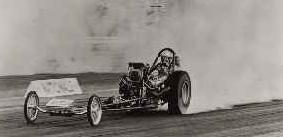
Swamp Rat 11
|
1968 started out with a tough loss at the season opening
Winternationals, a loss that came at the hands of James Warren, the same man he
had beaten five months earlier for the championship at Indianapolis. Any loss
for Don meant analyzing the reasons why and fixing them. After Pomona, he
headed back to Florida to come up with a new clutch design, a revolutionary
three-disc unit that he used for the first time at Englishtown for the NHRA
Springnationals. He won that race, beating John Mulligan in the finals, and
another Garlits innovation would soon be copied and used by most of his
competitors. As the year wore on, Don continued to rack up a series of wins on
the match-race circuit and he even set an unofficial record of 240 miles per
hour at Alton, Illinois. Then over the Labor day weekend, Don enjoyed what may
have been the best, single weekend of his life. He was named the Car Craft
“Man of the Year” prior to the Indy race, and then he went out and became the
first repeat winner in Nationals’ history when he beat Steve Carbone in the
final round. Three Indy wins, two consecutively and the adulation of the fans
and Don Garlits was on top of the world.
The following year wasn’t your typical Don Garlits season.
He was shutout on the national circuit and only had a few regional wins to show
for his efforts. But all of his struggles paled in comparison to what happened
at Indy in 1969. Don won the prestigious “Man of the Year” award for the second
consecutive year, but his euphoria quickly turned to sorrow when disaster
struck the drag racing fraternity at the Indianapolis race. John Mulligan, the
driving half of the Beebe and Mulligan team, was killed in an accident during
the first round of eliminations at the U.S. Nationals. Don, like all of the
drivers, was stunned by the incident. John was a tremendously popular young man
and one of the top drivers in the sport. The incident had an impact on
everyone, from the racers to the fans, and it affected Tom “The Mongoose”
McEwen so much that the great veteran actually withdrew from the event in order
to go to the hospital to be with John, who would cling to life for a few days
before succumbing to his injuries. At the track, Don, for some unknown reason,
hit the cutoff switch on his race car as it came to the starting line for the
first round of eliminations and he lost his chance to win Indy again without
even getting off the starting line. To this day Don doesn’t remember exactly
what happened, and he’ll also tell you that it didn’t matter because the sport
had lost a great competitor and everyone was saddened by the tragedy. All of a
sudden, winning a race wasn’t the mot important thing in the world.

Swamp Rat 12
|
In 1970, the American Hot Rod Association began a series
called their “Grand American” championships, a series where drivers would
accumulate points over the year with the champion receiving $20,000 at the end
of the season. Twenty grand in 1970 was a lot of money and Don was one of the
drivers who would contend for the title. After a win at the first race of the
year, he headed to Lions Drag Strip with his potent “Wynn’s Charger” dragster.
There, in his final round match with Richard Tharp, Don’s car exploded,
literally, right off the starting line, seriously injuring Don and cutting off
most of his right foot. As he recuperated in the hospital, one driver came to
visit him almost daily, trying to lift his spirits by just talking or watching
episodes of Don’s favorite television show, “Star Trek.” That driver was Tom
McEwen. All the while, as he talked to his friends or spent time trying to
rehabilitate himself, Don was thinking of returning to competition with a car
that would be safer for him and all of the other drivers in the Top Fuel class.
As hard as it is to believe, Don actually raced before the
summer of 1970 was over. Don went to Indy, where he won the “Ollie’ award at
the Car Craft banquet, an award that symbolizes the lifelong achievements
of the recipient. And, even though he had been seriously injured in a
“slingshot” dragster, Don felt comfortable getting back behind the wheel…and
behind the engine. All of that changed, however, when he saw Jim Nicoll’s car
come apart in the final round match with Don Prudhomme at Indy that year. The
clutch in Nicoll’s car exploded and came right through the bell housing and cut
the car in half. Jim tumbled down the track, miraculously unhurt, but after
seeing the results of the explosion, Garlits realized that the only safe place
for a driver in a Top Fuel car was in front of the motor, not behind it. He
began planning, right there, to create the first really successful and
competitive rear-engine dragster.

Swamp Rat 13
|
Most drag race fans think that Don debuted his new
rear-engine car at the NHRA Winternationals, but he actually made a couple of
runs prior to Pomona at the “Grand American” race at Long Beach and at an
independent affair at Orange County. At both tracks his new car was met with
skepticism, and it met defeat in the finals at the hands of Gary Cochran at
both races. All of that would change, however, at Pomona, where “Big Daddy”
qualified fifth and made his way to the final round, where he made a solo run
for the championship when Kenny Safford’s car couldn’t start. “Big Daddy” Don
Garlits had survived a horrible accident, created a revolutionary new car and
had proven to the world, and to himself, that this design could work. It was
quicker, faster and safer than any other car out there, and, as he had done so
many times before, Don Garlits made a huge impact on the sport. The
front-motored cars would hang on for a few more years, but anyone who wanted to
be really competitive, anyone who wanted to beat Don Garlits, had to switch to
the rear-engine design or be left behind, literally and figuratively.
1971 was a great year for Don, he was the
Drag
News “Man of the Year,” AHRA’s “Driver of the Year,” and
Popular Hot
Rodding magazine named him “Driver of the Decade.” Throw in a visit to the
White House and a trip overseas to visit the service men and women in Viet Nam
and 1971 was a very busy year for “Big Daddy.”
Maybe his best up to that time!
As always, it didn’t take Don too long to improve on the
“best year” of his drag racing career. 1972 saw his involvement with the U.S.
Navy begin, including that famous shot of him doing a burnout on the aircraft
carrier, Lex. He continued to put together an impressive list of wins in
every sanctioning body, winning the Gainesville and Lakeland, Florida events
for NHRA and IHRA wins, while steam rolling through the competition at the AHRA
events. But Don Garlits was a businessman as much as he was a racer, and he
deemed that the purses that the drivers were competing for were not keeping up
with the costs of running the cars. So, together with several other prominent
drivers and team owners, Don came up with the Professional Racers Association,
and they planned to stage the biggest race in the history of the sport, and
they’d run it on Labor Day weekend, the traditional time for the NHRA Nationals
at Indy. The group, backed by Jim Tice from the American Hot Rod Association,
would pay the winners in the three professional classes $25,000 each, the
largest payout ever in the sport. Most of the top teams went to the PRA race,
called “National Challenge,” in Tulsa, Oklahoma over the Labor Day weekend, and
when it was all over, Don Moody, Tom McEwen and Bill Jenkins were the big
winners. The following year, the group held the race again, but this time they
moved it off of the Labor Day weekend, enabling Don and all of the other PRA
members to race at both events, the “National Challenge” and the NHRA
Nationals. Oddly enough, the first year of the race, some of the team owners
who promised not to run at Indy, did find a way to compete at both events. With
Garlits not in the 1972 Indy field, a little known racer by the name of Gary
Beck won the race, while Ray Allen won the only Pro Stock race of his career.
The next year, with Garlits in the field, Beck not only won Indy again, but he
set records in both the speed and elapsed time categories, and that set off one
of the great rivalries of the day, Don Garlits vs. Gary Beck. The two would
stage some very memorable races over the next few years.

Swamp Rat 14
|
As the 1970’s rolled on, so did Don Garlits, and try as they
might, the rest of the Top Fuel drivers just couldn’t keep up with him, let
alone pass him. ’74 saw another AHRA championship, some more NHRA wins and
honors across the board, ranging from his induction into the Motorsports Hall
of Fame to another year as AHRA’s “Driver of the Year.” Add a fifth year on the
All American Auto Racing Writers and Broadcasters ballot and you have a lot of
hardware being piled up by Mr. Garlits. And just as 1975 came to a close, Don
made even more news when he not only won the NHRA Supernationals in Ontario,
California, and the NHRA World Championship (on the last day of the season),
but he made the run that was heard around the world. After setting a record at
that track in 1973, a record that stood for two years, Don came back and ran
the quickest and fastest run in the history of the sport, a mind-boggling 5.637
at 250.69 miles per hour, and that record would last for another six years.
Part 3….next week.

NHRA: 10 Most Recent Entries [ top ]
Apr 09- POMONA 1 - Thursday Schedule
Apr 08- Hood Scoops Set to Return to NHRA Pro Stock Category in 2027
Apr 07- PowerEdge Returns as Presenting Sponsor of DENSO NHRA Sonoma Nationals at Sonoma Raceway
Apr 07- GESi Pro Stock No. 1 Qualifier Award Returns for 2026 Season
Apr 06- POMONA 1 - Funny Car Preview
Apr 02- Revchem Composites Plays Critical Role in Ron Capps Motorsports' Continued Success
Apr 01- Second Wave of NHRA 75th Anniversary Commemorative Tickets Include Wealth of Legends
Mar 30- CHARLOTTE - Event Preview
Mar 30- BELLE ROSE - Super Gas Round 5 Eliminations
Mar 30- BELLE ROSE - HEMI Chootout Round 3 Eliminations









