


 |
 |
 |
 |

|
 |

 |
 |
 |
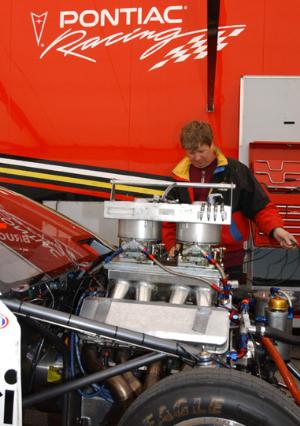
Finding more power is always a priority in Pro Stock, but there's also a reliability factor to consider as well. A lot of people think a GM DRCE II is built to be as light and as thin as possible. That's true to a certain extent, because a 500 cubic inch Pro Stock engine has so much power, and revs up so much higher, pushing the performance envelope to the very edge, the things that may barely be adequate in a Pro Stock motor will be more than adequate in an engine that produces 400 - 500 horsepower less. If you're a sportsman racer and you buy an engine from a reputable shop, one that's doing constant research and development, and is aware of all of the new technology available, you're getting extra benefits at no additional charge. On our Pro Stock engines, we're developing new parts that may only mean three to five additional horsepower for us, but those same advancements on a bracket motor may be worth an additional 15 to 20 horsepower! The GM 555 we will build next year, instead of being a 910 horsepower engine, could easily surpass 945 horsepower, and that's because we're utilizing new things we've discovered with our Pro Stock program.
Just one example of where we've made tremendous gains over the years has been in the area of cylinder heads. The cylinder heads we started out racing with years ago were around 18 degrees. Now the heads we use with our GM DRCE II engine are down to 10 degrees. As we keep tipping the valves in the head, making the combustion chamber nicer and more efficient, and getting a better burn, we have more compression with less piston dome, pick up efficiency, and have less detonation and pre-ignition. We've now been able to produce a higher end bracket motor with a 12-degree cylinder head that's pretty much a stock piece. Furthermore, we're in the process of developing a new cylinder head for bracket cars that will be equipped with a 10-degree head, something very similar to what we use with our Pro Stock engines. The neat thing about it is that it's going to be a dedicated casting, unlike a Pro Stock engine which is a raw block, and parts are moved one or two degrees at a time to optimize valve locations and angles. Even in the area of head gaskets we've made terrific progress that's been beneficial to all of our engine customers. Years ago we used copper head gaskets, put a special paint on them and used extra bolt holes to hold them. Now we use a multi-layered gasket that doesn't use a sealant, and puts a pressure point around the top of the cylinder so that it clamps on its own. It doesn't distort the bore as much and the clamping force is much higher per square inch on the gasket. Now we don't have to use o-ring blocks. Even nitrous motors can run a three-piece gasket without having leakage.
Other advancements have been made with engine blocks. There was a time when you'd scour junkyards to find a suitable piece. The GM-designed blocks that we now use, which still look very similar to the original Chevy Mark IV, allow us to create more power and efficiency than ever before using smaller diameter rod bearings, and almost small-block size main bearings. The crankshafts are made out of better material and the parts we use have gone down in size. We've also been able to lighten up all of our components. Our engines now have a bigger bore with less stoke, which means a lot less weight, so consequently, everything that goes along with it is smaller and lighter. And because the blocks have advanced in their simplicity, there's less opportunity for something to go wrong. The GM DRCE III that's coming out soon will be another new design of parts, technology and efficiency that will eventually be applied to all engines and another example of the trickle down effect that benefits everybody.
We've started a GM LS1 engine development program for street/strip Corvettes, Camaros and Firebirds. While I was taking apart the LS1, I noticed all of the factory-installed parts on a high-end car such as the Corvette that are also available in street motors and GM-built passenger cars - something most consumers never see or realize. The neat thing is that when you take the LS1 apart, you can see that it has a big diameter camshaft that's rifle drilled. The LS1 has very tight chambers on the cylinder heads and if you take it apart and leave the block sitting there, it looks like a racing engine. That's been passed down by GM Racing and GM engineers all the way down to the buying public, and whether you're buying a new Corvette, or Grand Am, or Monte Carlo, your driving experience is enhanced by GM Racing technology. In summary, everyone benefits in some way from the technology developed in motorsports. It's just that 95 percent of the time the casual observer doesn't realize it. But as we continue to develop more power, and discover better parts to improve the efficiency of our Pro Stock engine program, you can be assured that pretty soon it will trickle down to help everyone.
|
|





Ready to take your order at 1-800-230-3030 | Customer Service 1-800-517-1035